

Parking lot signs are not just markers - they are essential for safety, compliance, and traffic flow. Without proper signage, you risk accidents, legal issues, and confusion for both drivers and pedestrians. Here's what you need to know to choose the right parking lot signs:
- Compliance Matters: Follow the Manual on Uniform Traffic Control Devices (MUTCD) and ADA guidelines to avoid fines and ensure safety.
- Visibility is Key: Use reflective materials, high-contrast colors, and proper sizing for clear visibility day and night.
- Durability Saves Money: Aluminum signs with reflective sheeting last 7–15 years and require minimal maintenance.
- Tailor to Your Needs: Choose signs based on your property's traffic patterns, such as "No Parking", "Handicap Accessible", or directional signs.
- Proper Installation: Mount signs at the correct height (7 feet for most, 60 inches for ADA) and ensure they are easily visible and unobstructed.
The right parking lot signs make your property safer, easier to navigate, and legally compliant.
The Ultimate Guide to ADA-Compliant Parking Lots - Parking lot Striping Business
MUTCD Compliance Requirements for Parking Lot Signs
The Manual on Uniform Traffic Control Devices (MUTCD), issued by the Federal Highway Administration (FHWA), serves as a nationwide guideline for the design, installation, and use of traffic control devices. These standards go beyond mere uniformity - they help create safer, more predictable environments where drivers and pedestrians can quickly understand what actions are expected of them. Below, we’ll break down the essential MUTCD standards for parking lot signs and the risks of not adhering to them.
MUTCD Standards for Parking Signs
The MUTCD establishes clear requirements to ensure parking lot signs are both recognizable and effective. Here’s what you need to know:
- Color Coding: Red is used to indicate prohibitions (e.g., No Parking signs), green signals permitted areas, and white-on-red is reserved for Stop signs.
- Sign Dimensions: Specific sizes are mandated, such as 12 x 18 inches for No Parking signs and 30 x 30 inches for standard Stop signs (or 36 x 36 inches for multi-lane approaches).
- Visibility: All regulatory signs must either be retroreflective or illuminated to ensure visibility, even in low-light conditions.
- Shape Standards: Different shapes are assigned to specific sign types - Stop signs are octagonal, Yield signs are triangular, and most others are rectangular.
The MUTCD applies to roads "open to public travel", which includes areas like shopping centers, parking lots, airports, and sports arenas accessible to the public. Even for private properties with restricted access, such as gated communities, adopting these standards as best practices can enhance safety and demonstrate a commitment to due diligence.
Consequences of Non-Compliance
Failing to comply with MUTCD standards can lead to serious consequences, such as increased liability risks, lawsuits, and fines - especially when it comes to accessibility signage. Proper, compliant signage is a clear indicator that steps have been taken to ensure the safety of visitors and employees. On the other hand, inadequate or non-compliant signs can contribute to accidents, property damage, and injuries.
The current MUTCD is the 11th edition, released in December 2023. However, ten states have their own MUTCD editions, which must align closely with the national standard. Some also have state-specific supplements. Before purchasing or installing signs, it's crucial to confirm which version applies in your state. You can do this by checking your state Department of Transportation website or consulting local authorities.
Key Factors for Selecting Parking Lot Signs
Parking Lot Sign Material Comparison: Durability and Maintenance Guide
Once you've got a handle on MUTCD compliance, the next step is to evaluate the factors that ensure your signs are durable and meet site-specific needs. These considerations go beyond compliance, addressing practical conditions like visibility, resilience, and the unique requirements of your property.
Sign Size and Visibility by Location
While compliance sets the foundation, sign size and visibility need to adapt to the specific conditions of your property. For example, a 12 x 18 inch No Parking sign might work perfectly in a small lot but could be too small for a busy shopping center where drivers need to see restrictions from 100 feet away. Location plays a major role: urban lots with heavy pedestrian traffic often require larger signs placed at eye level, while rural areas with faster-moving vehicles benefit from higher-mounted, larger signs that are easy to spot from a distance.
Reflective sheeting is essential for visibility in all conditions. High-quality reflective materials ensure clear contrast during the day and make signs visible at night by reflecting headlights. This is particularly important in low-light or high-speed areas where quick recognition is critical.
Material Selection and Durability
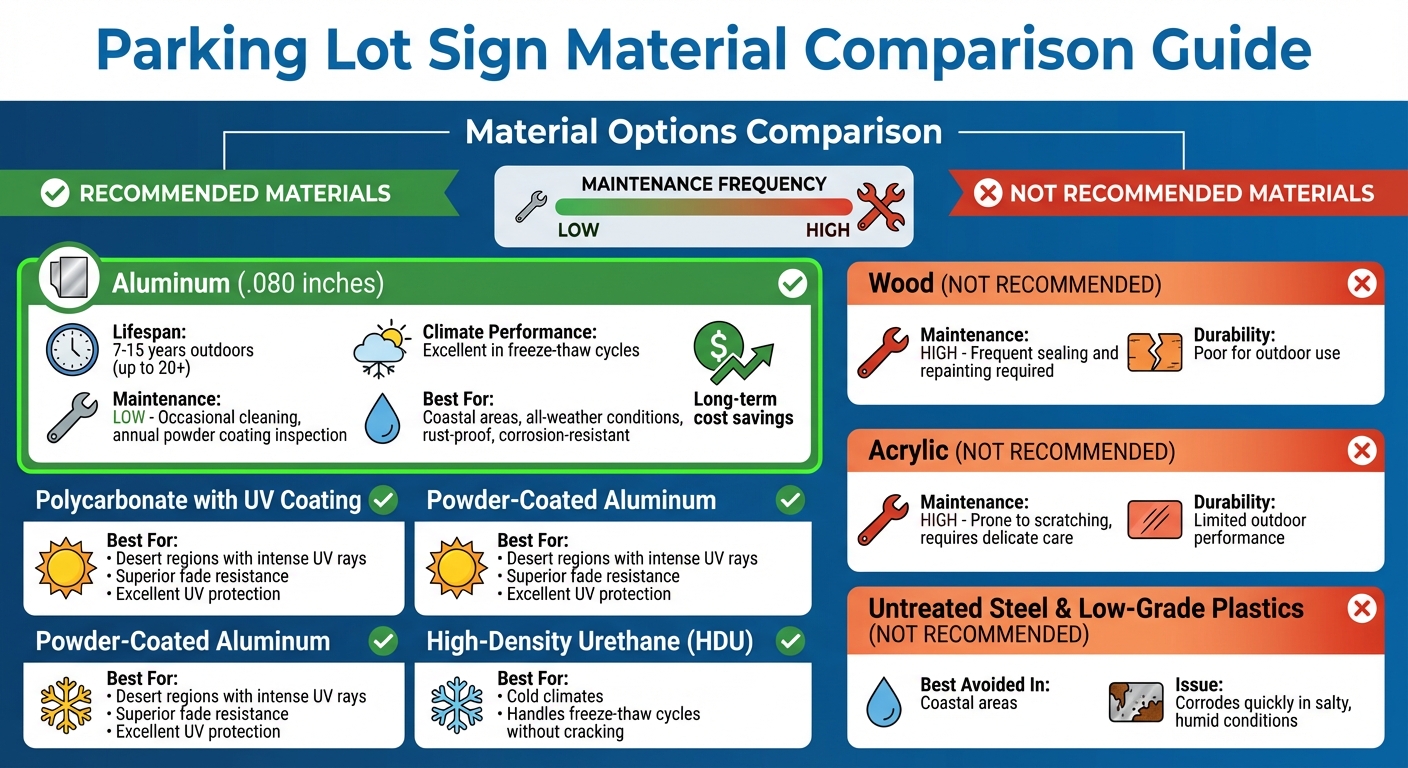
The environment where your signs are installed has a big impact on their lifespan. Aluminum sheeting with a thickness of .080 inches is a top choice for outdoor parking lot signs. It’s rust-proof, resists corrosion in areas with salty air, and can endure decades of exposure. Pair it with reflective sheeting and pre-drilled mounting holes, and you’re looking at a lifespan of 7–15 years outdoors, with some installations lasting over 20 years.
Choosing the right material for your climate is crucial. For coastal areas, avoid untreated steel and low-grade plastics as they corrode quickly in salty, humid conditions. In desert regions, where intense UV rays can fade materials, options like polycarbonate with UV coating or powder-coated aluminum offer superior fade resistance. For colder climates with freeze-thaw cycles, aluminum or High-Density Urethane (HDU) handle temperature changes without cracking.
Maintenance also matters. Aluminum is relatively low-maintenance, requiring only occasional cleaning with mild soap and water and an annual inspection of its powder coating. This is in stark contrast to wood signs, which need frequent sealing and repainting, or acrylic signs, which are prone to scratching and need delicate care. For signs in hard-to-reach areas, choosing low-maintenance materials can save time and money in the long run.
Matching Signs to Property Requirements
Once you’ve chosen materials suited to your environment, the next step is to align your signs with your lot’s operational needs. Large parking areas often need directional signs to guide drivers and reduce congestion. Properties with speed concerns benefit from well-placed speed limit signs that are easy to spot. Public facilities are also required to install ADA-compliant signs at designated spaces, including the International Symbol of Accessibility and markings for van-accessible spots.
Tailoring your signage to your property’s purpose is key. For instance, a hospital parking garage might need signs for emergency vehicle access, patient drop-off zones, and staff-only areas. On the other hand, a retail center or office building may prioritize managing customer and employee parking effectively. Combining these specific needs with MUTCD guidelines ensures a complete and functional signage system.
sbb-itb-5d58da3
Types of Parking Lot Signs and Where to Use Them
Choosing the right signs is essential to keeping your parking lot organized, safe, and easy to navigate. Depending on the material and size you select, these signs can help control traffic flow and ensure everyone follows the rules.
Regulatory Signs: No Parking, Handicap Accessible, and Reserved Parking
Regulatory signs are there to enforce rules that maintain safety and compliance in your parking lot. For example, No Parking signs stop vehicles from blocking critical areas like fire lanes, loading zones, entrances, or exits. You can use variations such as "No Parking Overnight" or "No Parking Loading Zone" to address specific needs, placing them at entry points or restricted areas.
Handicap Accessible parking signs are a legal requirement under ADA guidelines. These signs usually feature the International Symbol of Accessibility on a blue and white background. They must be mounted at an eye level and kept unobstructed. For spaces meant for wheelchair lifts, adding "Van Accessible" signs is recommended. According to ADA rules, lots must have at least one accessible parking space for every 25 regular spaces. Also, directional arrows on these signs should not interfere with ADA-accessible pathways.
Reserved Parking signs are used to designate spots for specific groups, such as visitors, employees, residents, or expectant mothers. They can also mark spaces for electric vehicle charging stations or energy-efficient vehicles.
Directional and Informational Signs
Clear directional and informational signs are key to improving traffic flow and reducing confusion in your lot. Directional signs - like "Parking Ahead" or arrows - help drivers find available spaces and navigate toward entrances, exits, or visitor parking areas. Place these signs at turns or intersections, giving drivers enough time to react.
Pedestrian crossing signs are especially important near high-traffic areas like entrances, exits, or school zones. Examples include "Slow Children" or "Stop for Pedestrians", which remind drivers to yield and slow down. You can also add signs that discourage distractions like texting while driving to enhance safety.
Other traffic control signs, such as Stop, Yield, One Way, Do Not Enter, and speed limit signs, ensure vehicles move safely within the lot. In areas with high turnover, time limit parking signs - like 15-minute, 30-minute, or 1-hour restrictions - help prevent congestion. Similarly, pick-up/drop-off signs can guide drivers in school zones or customer service areas.
Custom Signs for Specific Property Needs
Sometimes, standard signs aren’t enough to meet your property’s unique requirements. Custom signs allow you to tailor text, colors, logos, and designs to fit your needs. For example, you could create signs to number parking spots, reserve spaces for specific individuals, or incorporate branding that matches your property’s style.
When using custom signs, it’s important to ensure they comply with regulations. Many manufacturers provide custom options that are explicitly "DOT & MUTCD Compliant" and meet official reflectivity standards. If you’re creating custom regulatory signs - like a "No Parking" sign with specific towing details - be sure to include all legally required information, such as dimensions, lettering size, and towing company details, to make them enforceable. Blank signs offer even more flexibility, letting you write your own messages. Alternatively, stencils can be used to paint information directly onto surfaces, such as floor numbers, accessible spaces, or loading zones.
Where and How to Install Parking Lot Signs
Getting the placement and height of parking lot signs right is crucial for maintaining safety and meeting regulations. Poorly placed signs can lead to blocked views, confused drivers, and even legal troubles.
Mounting Heights and Distance Requirements
The federal MUTCD (Manual on Uniform Traffic Control Devices) specifies that traffic and regulatory signs in commercial, urban, business, or residential areas must be mounted at least 7 feet high. This height is measured from the bottom of the sign to the top of the curb (or the road edge) to prevent hazards for pedestrians and ensure clear visibility.
For ADA-compliant parking signs, the rules are even stricter. These signs must be mounted so the bottom edge is at least 60 inches above the ground. This ensures the signs remain visible over parked vehicles and can be seen from a driver’s seat. Additionally, space signs at least 200 feet apart or use a distance of 5–7 times the speed limit (in feet) to give drivers enough time to respond.
Positioning Signs for Safety and Accessibility
Proper mounting height is just one part of the equation - where you position signs also plays a big role in safety and accessibility. Place signs where drivers can easily spot them before they need to make decisions, such as before turns or intersections within the parking lot. For accessible parking spaces, signs should guide users to the shortest, level route leading to each entrance.
Always position signs perpendicular to traffic and free from any obstructions. At night, reflectivity isn't enough - make sure there’s adequate overhead lighting for visibility. For "No Unauthorized Parking" signs, install them prominently at all entry points and throughout the lot. Stop signs should be placed at intersections where drivers need to pause.
Regular upkeep is also essential. Trim back any landscaping that might block the view of signs to ensure they remain visible and effective.
Conclusion: Choosing the Right Parking Lot Signs
Key Takeaways for Sign Selection
When selecting parking lot signs, it’s crucial to prioritize legal compliance, visibility, and durability. Signs that meet MUTCD and ADA standards not only help you avoid fines but also ensure the safety of employees, customers, and pedestrians. Failing to comply with these federal standards can lead to confusion and accidents, putting everyone at risk.
Visibility plays a major role in preventing accidents. Opt for signs with high-contrast colors, reflective sheeting, and proper sizing tailored to your location. Consider this: although only 25% of driving happens at night, these hours account for 50% of car fatalities. Reflective materials improve visibility in low-light conditions, giving drivers the extra reaction time they need to stay safe.
Durability is another key factor. Aluminum signs are a smart choice - they resist rust and fading, requiring very little maintenance over time. By selecting materials suited to your local weather and factoring in potential vandalism risks, you can ensure your signs remain clear and legible for years.
In short, effective parking lot signs should combine compliance, visibility, and long-lasting durability to create a safer environment for everyone.
TrafficSafetyHQ Product Options
TrafficSafetyHQ offers a wide selection of MUTCD-compliant parking lot signs made from .080" aluminum and enhanced with 3M™ High Intensity Prismatic or Diamond Grade reflective sheeting. Their product range includes essential options like "No Parking", "Handicap Accessible", "Reserved Parking", and directional signs - all designed with pre-drilled holes for quick and easy installation.
If your property requires something more specific, their custom signage options allow you to add logos or personalized text, all while staying fully compliant with federal standards. Every sign comes with a 10-year guarantee and meets FHWA and ASTM D4956 requirements. Whether you’re looking for standard signs starting at $10.00 or custom solutions for unique needs, TrafficSafetyHQ ensures fast shipping, bulk order discounts, and flexible Net-30 terms for government and commercial clients.
FAQs
What are the advantages of choosing aluminum signs for parking lots?
Aluminum signs are an excellent choice for parking lots, offering a combination of practicality and resilience that property owners appreciate. These signs are built to withstand tough outdoor conditions, including rain, snow, and intense sunlight, without rusting or losing their color. This durability ensures they stay effective and visually appealing over time.
Another key benefit is their lightweight yet sturdy design. Many aluminum signs also come with reflective finishes, which boost visibility in low-light settings or at night. This makes them a dependable and budget-friendly solution for keeping parking areas safe and well-organized.
How do I make sure my parking lot signs meet MUTCD and ADA requirements?
When setting up parking lot signs, it's important to follow both MUTCD and ADA guidelines to ensure compliance. For dimensions, stick to MUTCD-approved sizes like 12" x 18" for standard signs. For accessible parking spaces, the International Symbol of Accessibility (ISA) on a blue background is a must to meet ADA requirements.
Make sure signs are mounted at least 60 inches above the ground to adhere to ADA height standards. Using reflective materials is also crucial for better visibility at night or in low-light conditions. Lastly, double-check your local regulations to ensure they align with these federal requirements.
What should I keep in mind when customizing parking lot signs for my property?
When designing parking lot signs, prioritize compliance, visibility, and durability to ensure they serve their purpose effectively. Start by making sure your signs adhere to MUTCD regulations - this helps you sidestep any legal complications. For readability, especially in low-light conditions, opt for reflective materials that enhance visibility both day and night. Additionally, choose weather-resistant options like aluminum or coated steel to handle outdoor wear and tear.
Tailor your signs to the specific needs of your property. Whether it’s reserved parking, handicap access, directional guidance, or time-limited parking, your signs should address these requirements clearly. Proper sizing and placement are critical - signs need to be noticeable without obstructing views. Use bold color coding and universal symbols to ensure drivers of all backgrounds can quickly understand the message.