

ADA parking signs are legally required under the Americans with Disabilities Act (ADA) to ensure accessibility for individuals with disabilities. Non-compliance can lead to fines starting at $75,000, lawsuits, and damage to reputation. Here's what you need to know:
- Signs Required: Every accessible parking space must have a sign with the International Symbol of Accessibility (ISA). Van-accessible spaces need an additional "Van Accessible" label.
- Placement: Signs must be mounted at least 60 inches above the ground for visibility, even when vehicles are parked.
- Design: Use reflective materials, high-contrast colors, and durable materials like aluminum. Fonts must be sans serif, with specific size and spacing.
- Space Requirements: The number of accessible spaces depends on the total lot size. One in six accessible spaces must be van-accessible with a vertical clearance of 98 inches.
- Maintenance: Regular inspections are essential to ensure visibility, durability, and compliance with updated regulations.
Proper signage ensures safety, meets legal standards, and avoids costly fines. Regular upkeep and adherence to federal, state, and local rules are non-negotiable for compliance.
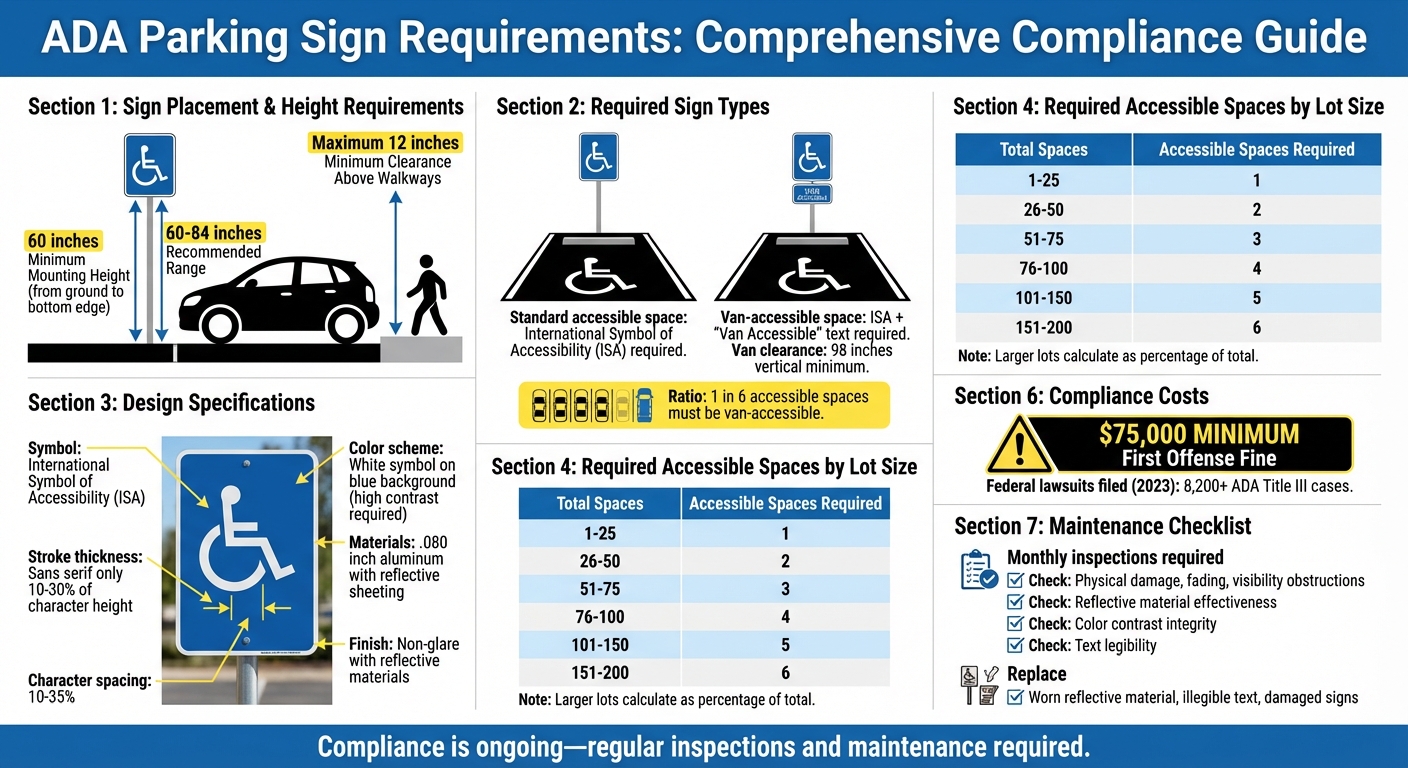
ADA Parking Sign Requirements: Height, Design, and Space Allocation Guide
Accessible Parking Video Fact Sheet
Basic ADA Parking Sign Requirements
Federal ADA standards outline specific requirements for parking signs, covering sign types, design elements, and common mistakes to avoid. Below, you'll find details to help ensure your signage meets compliance standards.
Required Sign Types
Every accessible parking space must have an above-ground sign featuring the International Symbol of Accessibility (ISA). Pavement markings alone don't meet the requirement since vehicles can obscure them. The bottom edge of the sign must be mounted at least 60 inches above the ground.
For van-accessible spaces, the signage must include both the ISA and the words "Van Accessible". At least one in every six accessible spaces should be van-accessible, offering extra width and a vertical clearance of at least 98 inches to accommodate wheelchair lifts or ramps. However, these spaces aren't restricted to vans only.
Additional enforcement signage, such as "reserved" or fine notices, is typically regulated by state or local laws. Facilities with four or fewer total parking spaces are exempt from posting signs for their single accessible space. Similarly, residential facilities are not required to post signs for spaces assigned to specific dwelling units.
Required Design Features
ADA-compliant parking signs must feature a high-contrast ISA, using either light-on-dark or dark-on-light color schemes. While federal guidelines don't specify an exact contrast ratio, a white symbol on a blue background is widely accepted and compliant.
To ensure visibility at night, signs must have a non-glare finish and include reflective materials. Durable materials like high-intensity reflective sheeting and aluminum are recommended to withstand outdoor conditions.
Any text, such as "Van Accessible", should be in a sans serif font. The uppercase "I" should have a stroke thickness between 10%-30% of its height, with spacing between characters ranging from 10%-35%. Avoid italic, script, or decorative fonts. Unlike indoor ADA signage, parking signs don't require tactile characters or braille.
Common Design Errors to Avoid
Here are frequent mistakes to watch out for:
- Missing the ISA symbol or "Van Accessible" text on designated spaces
- Using non-reflective or low-durability materials
- Failing to provide adequate color contrast
- Choosing improper fonts, sizes, or spacing
Sign Placement, Height, and Visibility
Installing signs properly isn’t just about meeting specifications - it’s about ensuring they’re placed where they’re most effective.
Mounting Height and Position
For ADA parking signs, the bottom edge must be at least 60 inches above the ground. This ensures the sign remains visible even when vehicles are parked. Signs can be mounted on posts, walls, or ceilings, typically at the head of the parking space or next to the access aisle.
The U.S. Access Board emphasizes:
"Accessible parking spaces must be identified by signs with the ISA. The bottom edge of each sign must be at least 60 inches high measured from the ground surface so that they are visible while vehicles are parked in a space."
While 60 inches is the federal minimum, some guidelines suggest a height range between 60 and 84 inches for better visibility. For van-accessible spaces with angled parking, it’s essential to place the access aisle on the passenger side, as that’s where ramps typically deploy.
Lastly, check for any nearby structures or objects that might block the sign’s visibility.
Visibility and Obstruction Prevention
To keep signs visible, avoid placing them where landscaping, pillars, or other objects could obstruct them. If a sign is suspended above a circulation path, it should have at least 80 inches of headroom. For post-mounted signs with leading edges between 27 and 80 inches, make sure they don’t extend more than 12 inches into walkways.
When accessible routes pass in front of parking spaces, install wheel stops to maintain the required 36-inch clear width. Access aisles should also remain clear of any obstructions - no bollards, columns, or poles should infringe on this space.
Access Aisle and Route Signage
Once the signs are in place, ensure access aisles are clearly marked. Use paint or hatch marks to designate these areas and discourage parking. Adding a "No Parking – Access Aisle" sign reinforces the message. These markings and signs help maintain safe and unobstructed paths for users exiting their vehicles.
For parking facilities with van-accessible spaces, post signs at entrances indicating the required 98-inch minimum vertical clearance. If your facility has multiple accessible entrances, distribute accessible parking spaces to ensure convenient access. For entrances that are not accessible, install directional signs that meet visibility standards to guide users to the nearest compliant entrance.
sbb-itb-5d58da3
Accessible Space Count and Designation
Counting and designating accessible parking spaces isn't just about meeting regulations - it's about ensuring everyone has equal access. Each parking facility, whether it's a surface lot or a parking garage, is evaluated separately to determine the required number of accessible spaces.
Calculating Required Spaces
Accessible parking requirements follow a tiered system. For instance:
- Lots with 1–25 spaces need at least one accessible space.
- Lots with 26–50 spaces require a minimum of two accessible spaces.
- Larger lots calculate the number of accessible spaces as a percentage of the total spaces.
Additionally, one out of every six accessible spaces must be van-accessible. For facilities with four or fewer parking spaces, a single van-accessible spot is required, though signage isn't mandatory in these cases. Van-accessible spaces must provide at least 98 inches of vertical clearance for the parking space, access aisle, and vehicular route.
After determining the required number of spaces, it's equally important to ensure proper stall markings and signage to meet compliance standards.
Stall Markings and Signage
Each accessible parking space must include the International Symbol of Accessibility (ISA), as outlined in the "Basic ADA Parking Sign Requirements" section. For van-accessible spaces, an additional "Van Accessible" sign must be displayed alongside the ISA. Access aisles - critical for mobility device users - should be clearly marked with paint or hatch patterns to prevent misuse by other vehicles.
Keep in mind that some facilities may require slight adjustments to these standards based on their specific purpose.
Requirements for Specific Facility Types
Certain types of facilities have unique parking accessibility needs:
- Hospital outpatient facilities: At least 10% of patient and visitor parking must be accessible.
- Rehabilitation and outpatient physical therapy facilities: Require 20% of parking spaces to be accessible.
- Other medical facilities: Follow standard parking guidelines.
- Residential settings: Accessible parking is based on the ratio of parking spaces to dwelling units. If specific spaces are assigned to individual units, additional signage isn't necessary.
- Employee parking lots: Must adhere to the same accessibility standards as visitor parking.
Inspection, Maintenance, and Product Selection
Ensuring ADA parking sign compliance isn’t a one-and-done task - it requires consistent inspections and upkeep. Set up a monthly inspection routine to check for issues like physical damage, fading, or anything obstructing visibility. Back in January 2025, Erie Custom Signs highlighted the importance of regularly repainting faded markings on accessible parking spaces to prevent wear and avoid compliance problems. These inspections help identify issues early, allowing for timely maintenance or replacement.
Regular Inspection and Maintenance
Take a close look at your parking areas every month to evaluate the condition and visibility of your signs. Check that reflective sheeting remains effective, especially for nighttime visibility under headlights. Pay attention to the International Symbol of Accessibility and any "Van Accessible" text to ensure they’re still easy to read. Also, verify that the color contrast between the text and background hasn’t diminished. Keeping a record of these inspections can show your commitment to compliance, which could be helpful if any disputes arise later.
When to Replace Signs
Replace signs as soon as you notice issues like worn reflective material, illegible text, or compromised physical integrity. ALTIUS Graphics puts it simply: "A damaged sign with worn tactile characters or missing braille dots does not provide accessibility. This can lead to the same legal penalties as a new non-compliant sign". Additionally, be prepared to update your signs when regulations change - new visibility standards in the 2025 ADA updates may require adjustments. Considering that fines for non-compliance start at $75,000 for a first offense, replacing damaged or outdated signs promptly is a wise choice. Once replacements are made, focus on selecting high-quality products to maintain compliance over the long term.
Selecting Compliant Sign Products
Good maintenance naturally leads to choosing signs built for durability and compliance. Opt for signs made from .080 inch aluminum with high-intensity prismatic or engineer-grade reflective sheeting. Some local regulations may even require diamond-grade reflectivity, so it’s a good idea to check your municipality’s codes before purchasing. For example, TrafficSafetyHQ produces signs using .080" aluminum and 3M™ reflective sheeting, meeting MUTCD and ASTM standards with a 10-year durability guarantee. As PRI Graphics & Signs points out, "Not all ADA signs are created equal. Simply slapping a generic 'handicap' sign from the hardware store onto a pole doesn't cut it". Work with vendors who understand both federal guidelines and any additional state-specific requirements, such as penalty notifications or tow-away warnings.
Conclusion
Staying compliant with ADA parking sign requirements boils down to three key factors: using the correct sign types, placing them properly, and ensuring they’re well-maintained. Signs must feature the International Symbol of Accessibility, be mounted at least 60 inches above the ground, and use reflective materials so they’re visible both day and night. The stakes are high - just in 2023, more than 8,200 ADA Title III federal lawsuits were filed, and first-offense fines can start at $75,000. These penalties make non-compliance a risk no one can afford.
Compliance isn’t a one-and-done task. As Erie Custom Signs points out, "ADA compliance is not a one-time effort - it requires ongoing attention". Regular inspections and a proactive mindset not only safeguard your organization but also ensure accessibility for those who depend on it.
Investing in quality materials and products is equally important. Generic signs often fall short of meeting federal and state standards. PRI Graphics & Signs explains it well: "Not all ADA signs are created equal. Simply slapping a generic 'handicap' sign from the hardware store onto a pole doesn't cut it". Opt for vendors who understand both federal ADA guidelines and local regulations, and who use durable materials like .080 inch aluminum and proper reflective sheeting.
FAQs
What happens if ADA parking sign requirements are not followed?
Failing to meet ADA parking sign requirements can lead to serious consequences. These include legal penalties, fines that can reach up to $4,000 per violation, and the possibility of lawsuits. In addition, non-compliance might require mandatory retrofitting orders to address deficiencies, which can be both expensive and time-consuming.
But the impact doesn't stop there. Ignoring ADA standards can damage your reputation, especially if your property is perceived as unwelcoming or inaccessible. By staying compliant, you're not just avoiding fines and legal troubles - you’re also showing a commitment to creating an environment that values accessibility and inclusion.
How often should ADA parking signs be checked and maintained?
ADA parking signs need a thorough inspection and maintenance at least once a year to ensure they meet compliance standards. During these checks, focus on visibility, correct height, reflective quality, and the overall condition of the signs.
Regular maintenance is essential to counteract damage from weather or vandalism, keeping the signs clear and compliant with ADA guidelines. In areas with heavy traffic, more frequent inspections might be required to ensure both safety and accessibility are upheld.
What are the key design requirements for ADA-compliant parking signs?
ADA-compliant parking signs are designed with clear, easy-to-read characters and raised tactile elements, ensuring they can be understood by a wide range of users. They must also prominently feature the International Symbol of Accessibility for quick identification.
To enhance visibility, these signs typically use high-contrast colors - for example, white text on a blue background is a common choice. Additionally, they need to be installed at a minimum height of 60 inches from the ground to the bottom edge and positioned in clearly visible spots near the designated parking spaces. These requirements help ensure the signs are practical and accessible for everyone.