

Reflective sheeting ensures traffic signs remain visible in all conditions, improving safety by reflecting light back to drivers. 3M leads this space with durable, high-performance materials that meet ASTM D4956 and MUTCD standards. Here's what you need to know:
-
Types of Reflective Sheeting:
- Engineer Grade (Type I): Budget-friendly, lower reflectivity. Ideal for parking lots and low-traffic areas.
- High Intensity Prismatic (Type III/IV): Medium to high reflectivity, lasting up to 10 years. Best for regulatory signs on roads with light to moderate traffic.
- Diamond Grade DG³ (Type IX/XI): Highest reflectivity, with up to 12 years of durability. Perfect for high-traffic roads and challenging placements.
-
Key Factors:
- Brightness: Higher types reflect more light, aiding visibility.
- Durability: UV-resistant materials ensure long-lasting performance.
- Angles: Products like Diamond Grade DG³ work well for wider viewing angles, benefiting drivers of larger vehicles.
-
Applications:
- Road Signs: HIP and DG³ are common for stop signs, speed limits, and warnings.
- Parking Lots: Engineer Grade works well for slower traffic zones.
- Construction Zones: HIP sheeting ensures clear visibility in temporary setups.
Choosing the right 3M reflective sheeting depends on traffic conditions, placement, and required brightness. High Intensity Prismatic and Diamond Grade options are ideal for demanding environments, while Engineer Grade suits simpler needs. Always ensure compliance with ASTM and MUTCD standards for safety and reliability.
ASTM D4956 Reflective Sheeting Types
ASTM D4956 Performance Classes
ASTM D4956 organizes reflective sheeting into categories based on brightness, durability, and intended use. For traffic control, the most common types are I, III, IV, IX, and XI.
- Type I (Advanced Engineer Grade) offers the lowest level of reflectivity, making it ideal for areas like parking lots or warehouses where high visibility isn't as critical.
- Type III and IV (High Intensity Prismatic) deliver medium to high reflectivity, meeting the standards required for regulatory signs on roadways and by Departments of Transportation (DOT).
- Type IX and XI (Diamond Grade) are at the top of the spectrum, with exceptional reflectivity. For instance, Type XI reflects nearly 60% of light - almost double that of other prismatic options. These are best suited for permanent DOT projects, areas with moderate to heavy traffic, warning signs, and challenging placements like overhead or left-shoulder signs.
3M produces reflective sheetings aligned with these ASTM standards, such as the Engineer Grade Prismatic Series 7300 (Type I), High Intensity Prismatic Series 3930 (Type III/IV), and Diamond Grade DG³ Series 4000 (Type IX/XI).
Knowing these classifications helps in selecting the right 3M product to meet specific traffic safety requirements.
Factors That Affect Reflective Sheeting Performance
While ASTM classifications provide a baseline, real-world performance depends on additional factors that influence how well reflective sheetings function. Here's what to consider:
- Retroreflection efficiency: Higher-rated sheetings reflect more light back to drivers, enhancing visibility over longer distances. This is especially important on high-speed roads where drivers need extra time to respond.
- Observation and entrance angles: These angles significantly impact visibility. For example, Diamond Grade DG³ (Type XI) performs exceptionally well at wider angles. This makes it ideal for vehicles like trucks and buses, where drivers sit higher and view signs from different perspectives. Consistent brightness across varying angles ensures all drivers can see the signs clearly.
- Durability and service life: Longevity matters, especially in harsh weather. 3M's High Intensity Prismatic and Diamond Grade materials provide UV-resistant reflectivity for up to 10 and 12 years, respectively. This durability reduces replacement costs and ensures compliance with the MUTCD's retroreflectivity standards over time.
Understand Signage : Types of 3M Reflective Laminates use in Signage
3M Reflective Sheeting Types and Their Uses
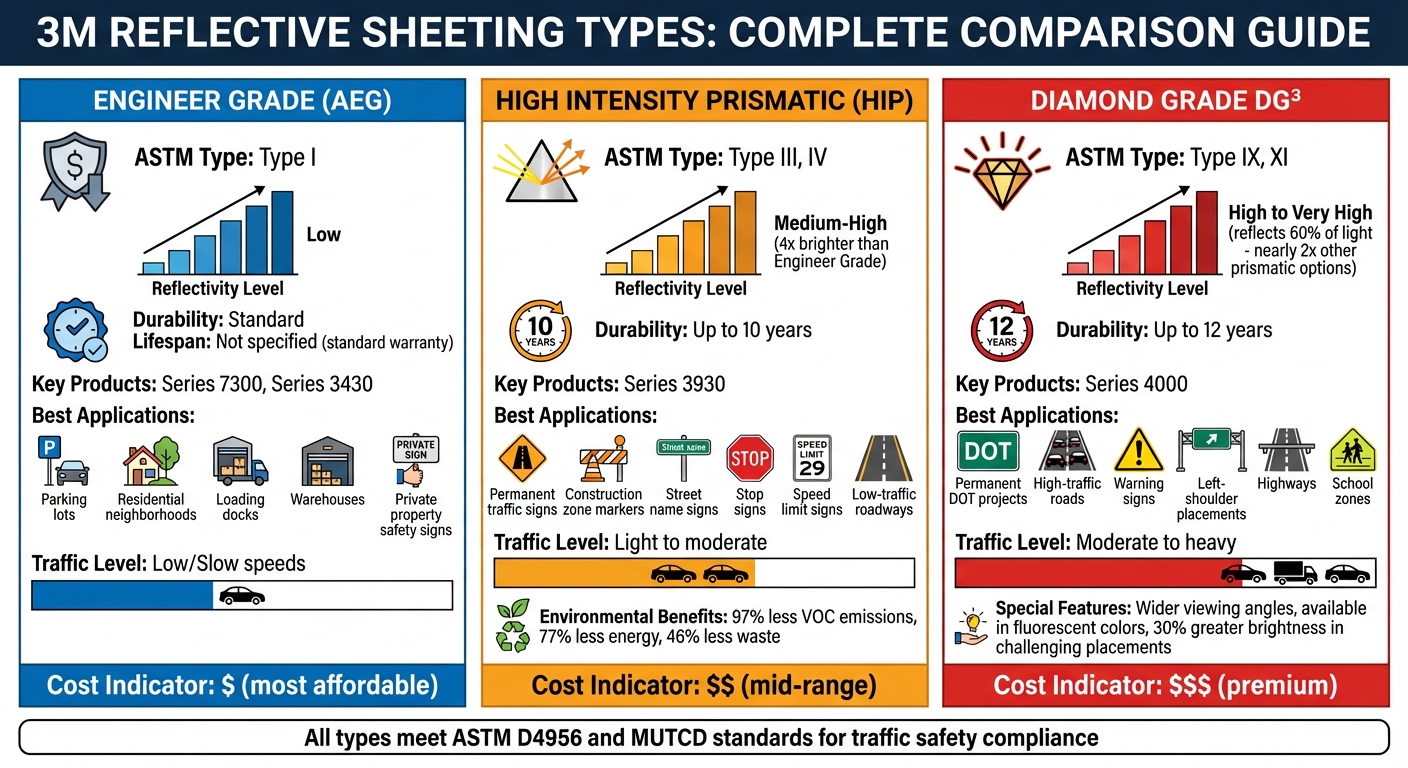
3M Reflective Sheeting Types Comparison: Engineer Grade vs High Intensity vs Diamond Grade
Based on ASTM classifications, 3M offers a range of reflective sheeting products tailored for traffic control. Each type serves unique purposes, making it easier to choose the right material for your signage needs.
3M Engineer Grade Reflective Sheeting
3M Engineer Grade Reflective Sheeting (AEG) is the most budget-friendly option, falling under ASTM D4956 standards. It provides a basic level of reflectivity and includes products like the 3M™ AEG Reflective Series 7300 and the 3M™ Engineer Grade Prismatic Sheeting Series 3430. This sheeting works well for areas where vehicles travel at slower speeds, such as parking lots, residential neighborhoods, loading docks, warehouses, and private property safety signs.
3M High Intensity Prismatic Reflective Sheeting
For a step up in reflectivity and durability, there’s the 3M High Intensity Prismatic (HIP) Reflective Sheeting, like the Series 3930. This non-metalized microprismatic sheeting meets ASTM D4956 Type III and IV standards, offering medium to high reflectivity. It’s built for long-term use, with features like a UV-resistant top film and a scratch-resistant topcoat, ensuring durability for up to 10 years. HIP sheeting is commonly used for permanent traffic signs, construction zone markers, street name signs, stop signs, and speed limit signs on roads with lighter traffic. Plus, its manufacturing process is environmentally friendly, reducing VOC emissions by 97%, energy use by 77%, and solid waste by 46% compared to older encapsulated lens options.
3M Diamond Grade DG³ Reflective Sheeting
The 3M™ Diamond Grade™ DG³ Reflective Sheeting Series 4000 represents the top-tier option in 3M’s lineup. Meeting ASTM D4956 standards for Type IX and XI, this sheeting reflects nearly 60% of available light - almost double that of other prismatic sheetings. It’s ideal for high-visibility applications, including permanent DOT projects, roads with moderate to heavy traffic, warning signs, and challenging placements like overhead or left-shoulder locations. With wider entrance and observation angles, Diamond Grade sheeting enhances visibility for drivers of larger vehicles or those needing improved clarity. Available in standard and fluorescent colors, it offers reliable performance for up to 12 years, ensuring visibility in all lighting conditions.
| Sheeting Type | ASTM Type | Reflectivity Level | Typical Durability | Best Applications |
|---|---|---|---|---|
| Engineer Grade (AEG) | Type I | Low | Standard | Parking lots, neighborhoods, loading docks, warehouses, safety signs |
| High Intensity Prismatic (HIP) | Type III, IV | Medium-High | Up to 10 years | Low-traffic roadways, regulatory signs, construction zones |
| Diamond Grade DG³ | Type IX, XI | High to Very High | Up to 12 years | DOT projects, high-traffic roads, warning signs, difficult placements |
sbb-itb-5d58da3
How to Choose the Right Reflective Sheeting
To select the right reflective sheeting, start by determining the required ASTM D4956 type. Once you’ve identified the type, consider the sign’s location, traffic conditions, and visibility needs. These factors will guide you to the most suitable 3M product for the job.
Regulatory and Warning Road Signs
For regulatory signs on public roadways - like stop signs, speed limit signs, and street name signs - 3M High Intensity Prismatic Reflective Sheeting meets the minimum standards set by the Department of Transportation. For warning signs or roads with moderate to heavy traffic, 3M Diamond Grade DG³ Reflective Sheeting is a top choice. It provides up to 30% greater brightness, especially in challenging placements. If the signs are for roads outside major traffic areas, you may need to adjust your selection to match the specific requirements.
Parking Lot and On-Site Traffic Control Signs
For areas where visibility demands are lower, 3M Engineer Grade Reflective Sheeting is a budget-friendly option. This sheeting works well for private property applications, such as ADA-compliant handicap parking signs, visitor parking signs, and reserved parking signs, where traffic speeds are generally slower.
Construction Zones and Temporary Traffic Signs
Construction zones require reflective sheeting that ensures clear visibility in all conditions. 3M High Intensity Prismatic Reflective Sheeting, which meets ASTM Type III/IV standards, is durable and can last up to 10 years. For work zones where visibility is especially critical, products like 3M™ Diamond Grade™ Work Zone Sheeting 3924S in fluorescent orange offer excellent retroreflectivity, along with impact and gouge resistance. This ensures reliable performance day and night.
Conclusion
Choosing the right 3M reflective sheeting is essential for ensuring both safety and compliance. The selection process should consider factors like traffic volume, required brightness, and durability. For areas with light traffic, such as parking lots or private properties, 3M Engineer Grade Prismatic is a cost-effective option that meets ASTM Type I standards. For more demanding settings like construction zones or permanent roadway signs, 3M High Intensity Prismatic provides approximately four times the brightness of Engineer Grade and offers up to 10 years of reliable service. When maximum visibility is critical - think highways, school zones, or areas with challenging weather conditions - 3M Diamond Grade DG³ stands out with its superior retroreflectivity and a 12-year warranty.
Meeting MUTCD compliance is not just a legal requirement but a crucial step in maintaining public safety on both public roads and accessible private property. By selecting reflective sheeting that aligns with ASTM D4956 specifications, you ensure your signs meet regulatory standards while providing optimal visibility.
TrafficSafetyHQ produces federally compliant traffic signs using durable .080" aluminum and 3M reflective sheeting, all backed by a 10-year durability guarantee. Whether you need road signs, parking lot markers, or construction zone signage, choosing the appropriate reflective sheeting ensures your signs remain visible and dependable, protecting both drivers and pedestrians day and night.
FAQs
What are the main differences between Engineer Grade, High-Intensity Prismatic, and Diamond Grade reflective sheetings?
Engineer Grade (EG) is the most basic option for reflective signage. It uses small glass beads or simple prismatic film to bounce back light, offering visibility of up to 500 feet at night. This makes it suitable for non-essential signs like parking lot markers or decorative decals. The reflectivity typically lasts around 5–7 years, making it a budget-friendly choice for less demanding applications.
High-Intensity Prismatic (HIP) steps things up with a prismatic cell structure that reflects light much more effectively than EG. It’s about three times brighter, providing visibility of up to 1,000 feet at night. This makes it a great option for most regulatory and roadway signs. HIP is also more durable, making it a solid choice for everyday traffic scenarios.
Diamond Grade (DG) is the top-tier option, built with advanced prismatic technology for unmatched brightness - up to ten times brighter than EG. It ensures visibility from over 1,500 feet, making it the go-to choice for critical signs like highway markers or areas requiring high visibility, such as high-speed corridors. DG also boasts the longest lifespan of the three, making it a reliable option for demanding environments.
How can I choose the best 3M reflective sheeting for different traffic conditions?
To choose the right 3M™ reflective sheeting, start by evaluating the traffic environment and determining the ASTM D4956 type required by MUTCD standards.
For areas with low speed and visibility - like parking lots, residential streets, or warehouses - 3M Advanced Engineer Grade (AEG) sheeting (Type I) is a budget-friendly choice that provides adequate reflectivity for these conditions.
In medium-speed areas or locations needing better visibility, such as primary or secondary roads, 3M High-Intensity Prismatic (HIP) sheeting (Type III/IV) is a great option. It offers improved reflectivity and performs well at wide angles, making it suitable for traffic signs and construction zones.
For high-speed highways or situations requiring maximum visibility, 3M Diamond Grade™ sheeting (Type IX/XI) provides the highest level of retroreflectivity. It ensures clear visibility over long distances and meets strict MUTCD standards.
To make the best choice, assess the traffic environment, confirm the required ASTM type, and align it with the appropriate 3M grade. This approach ensures your signs remain visible, durable, and fully compliant with safety regulations.
Why is it important for reflective sheeting to meet ASTM D4956 and MUTCD standards?
Meeting ASTM D4956 and MUTCD standards is essential for ensuring traffic signs meet critical safety, performance, and durability benchmarks. These standards are designed to guarantee that reflective sheeting provides the necessary visibility and reliability, particularly during nighttime or in challenging weather conditions.
ASTM D4956 focuses on technical requirements like reflectivity levels and weather resistance, making sure signs remain effective over time. Meanwhile, the MUTCD adopts these specifications as part of its legal framework for traffic control devices across the U.S. This ensures signs consistently deliver proper retroreflection, accurate colors, and strong adhesion.
Compliance with these standards not only reduces safety risks but also ensures uniformity on roadways and helps avoid penalties for non-compliance. By following these guidelines, road safety improves, and drivers can rely on clear, consistent traffic guidance nationwide.