

Reserved parking signs are essential for ensuring accessible parking spaces meet ADA (Americans with Disabilities Act) requirements. These signs, featuring the International Symbol of Accessibility, remain visible year-round, unlike pavement markings that can fade or be obstructed by snow or debris. Proper signage not only helps individuals with disabilities locate accessible spaces but also prevents misuse and meets federal legal standards.
Key Points:
- ADA Signage Requirements: Signs must include the International Symbol of Accessibility (ISA) and, for van-accessible spaces, additional "Van Accessible" text. They must be mounted at least 60 inches above the ground.
-
Common Compliance Issues:
- Missing or incorrect signage.
- Over-reliance on pavement markings.
- Improper height or placement of signs.
- Parking Space Ratios: The number of accessible spaces depends on total parking spaces, with at least one in six accessible spaces designated for vans.
- Installation and Maintenance: Signs must be durable, weather-resistant, and regularly inspected to ensure compliance.
Ensuring proper signage is not just about avoiding fines - it reflects a commitment to accessibility and equal access for all.
Accessible Parking Video Fact Sheet
Common ADA Compliance Problems With Reserved Parking Signs
Property owners can sometimes stumble into compliance issues that lead to fines or legal challenges. Understanding these common mistakes is key to keeping your business in line with federal standards. Let’s break down some frequent errors that could jeopardize compliance.
Missing or Incorrect Accessibility Symbols
Every accessible parking space must feature the International Symbol of Accessibility (ISA) on a vertical sign. A common oversight is relying exclusively on pavement markings, which don’t meet federal ADA requirements. Why? Because these markings can be hidden when vehicles park over them, rendering them ineffective. For van-accessible spaces, there’s an added requirement: two signs are necessary - one with the ISA and another labeled "van accessible". Ensuring proper mounting and visibility of these signs is just as important as having the correct symbols.
Improper Sign Mounting and Placement
ADA regulations specify that accessible parking signs must be mounted at least 60 inches off the ground, measured to the bottom of the sign. This height ensures visibility over parked cars and avoids obstructions like tree branches or light fixtures. Signs mounted too high or too low can create challenges for wheelchair users or individuals with limited mobility, making proper placement critical.
Over-reliance on Pavement Markings
Surface markings, while useful, are not enough to meet ADA standards. As Rose Paving points out, “painted symbols alone are not sufficient. Permanent, vertical signage is required”. Pavement markings can fade over time or be covered by snow, debris, or parked vehicles, making them unreliable. To comply, each accessible space must have a vertical sign mounted at the required 60-inch height. For van-accessible spaces, an additional "van accessible" sign is mandatory. Ignoring this requirement not only violates federal guidelines but could also result in fines as high as $75,000.
Federal ADA Requirements for Reserved Parking Signs
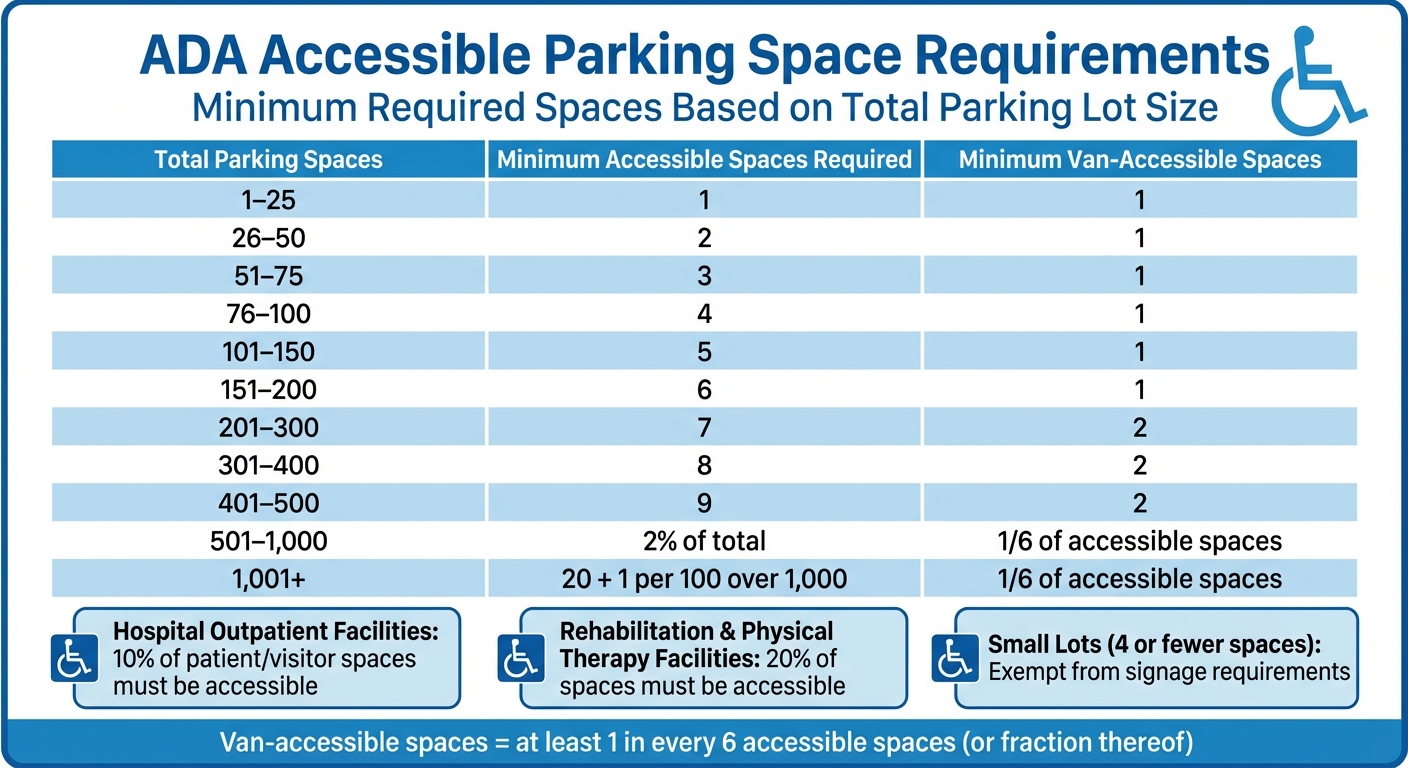
ADA Accessible Parking Space Requirements by Total Lot Size
Navigating ADA regulations is crucial to avoid compliance issues and unnecessary costs. The federal ADA Standards establish the foundational guidelines applicable across the country, though state or local laws may include additional rules. Below, we’ll break down the key features, mounting rules, and parking space ratios that ensure ADA compliance.
Required Sign Features
All accessible parking spaces must feature the International Symbol of Accessibility (ISA) - the recognizable blue-and-white wheelchair icon - displayed on a vertical sign.
While the ADA Standards don’t mandate specific colors, dimensions, or reflectivity for these signs, they do require a non-glare finish and high-contrast characters and symbols to ensure readability. Additional design details, such as color contrast or reflective materials, are often outlined in local building codes or the Manual on Uniform Traffic Control Devices (MUTCD).
Sign Placement and Mounting Standards
Signs must be mounted at least 60 inches above the ground, measured to the bottom edge of the sign, regardless of how they are installed. For overhead signs, a minimum headroom clearance of 80 inches is required. Signs can be mounted on posts, walls, or even suspended from ceilings.
Accessible parking spaces and their signs should be located along the shortest accessible route to an accessible entrance. For facilities with multiple accessible entrances, accessible spaces should be distributed among them. Signs should be positioned at the head of the parking space or within the adjacent access aisle to clearly mark the designated area.
Accessible Parking Space Ratios
The number of accessible parking spaces required depends on the total number of spaces in each parking facility, with calculations done separately for each lot or garage. For instance, a facility with 100 spaces must have four accessible spaces, while one with 500 spaces needs nine. Additionally, at least one in every six accessible spaces (or any fraction thereof) must be van-accessible.
| Total Spaces | Minimum Accessible Spaces | Minimum Van Spaces |
|---|---|---|
| 1–25 | 1 | 1 |
| 26–50 | 2 | 1 |
| 51–75 | 3 | 1 |
| 76–100 | 4 | 1 |
| 101–150 | 5 | 1 |
| 151–200 | 6 | 1 |
| 201–300 | 7 | 2 |
| 301–400 | 8 | 2 |
| 401–500 | 9 | 2 |
| 501–1,000 | 2% of total | 1/6 of accessible spaces |
| 1,001+ | 20 + 1 per 100 over 1,000 | 1/6 of accessible spaces |
Certain facilities must meet stricter requirements. For example, hospital outpatient facilities must allocate 10% of patient and visitor spaces as accessible, while rehabilitation and outpatient physical therapy facilities are required to designate 20% of their spaces for accessibility. However, small lots with four or fewer total spaces are exempt from signage requirements, though they must still comply with all other accessibility standards.
sbb-itb-5d58da3
How to Achieve and Maintain ADA Compliance
Ensuring your parking area meets ADA standards for reserved parking signs involves a step-by-step approach. From assessing your current setup to maintaining compliance over time, property managers and facility teams need a clear plan to avoid penalties and ensure accessibility.
Conduct a Compliance Audit
Start by identifying and documenting all accessible parking spaces and their signage. Use a measuring tape and a checklist to walk through your parking lot, checking that each sign includes the International Symbol of Accessibility (ISA) with proper contrast and a non-glare finish. For van-accessible spaces, confirm the "Van Accessible" text appears below the ISA.
Measure the height of each sign, ensuring the bottom edge is at least 60 inches above the ground. Signs should be mounted on permanent posts positioned in front of designated spaces, remaining clearly visible even when vehicles are parked. Additionally, for post-mounted signs with leading edges between 27 and 80 inches high, verify they don't extend more than 12 inches into walkways.
Check the dimensions of parking spaces and access aisles, ensuring they align with federal standards. Access aisles should be clearly marked, match the length of the parking space, and maintain the correct slope.
This detailed audit helps identify gaps and sets the foundation for selecting compliant signage and proper installation.
Select Compliant Signs
After identifying deficiencies, focus on acquiring signs that meet ADA requirements. Look for signs that prominently feature the ISA and include "Van Accessible" text for designated spaces. Make sure the bottom edge of the signs can be mounted at least 60 inches above ground, with high-contrast text and non-glare finishes for better visibility.
Durability matters too. TrafficSafetyHQ, for example, produces ADA-compliant parking signs using .080" aluminum with 3M™ reflective sheeting, offering up to 10 years of outdoor durability. These signs resist rust and meet MUTCD and ASTM standards. Depending on your lighting conditions, you can choose between Engineer-Grade reflective material (visible up to 500 feet) or High-Intensity reflective material (visible up to 1,000 feet). Protective overlaminates can further extend the life of the signs by shielding them from fading, graffiti, and chemicals.
Lastly, cross-check federal ADA standards with local regulations, as local codes may have stricter requirements.
Install and Maintain Signs for Long-Term Compliance
Once you’ve selected the right signs, proper installation and regular upkeep are key to staying compliant. Install signs at the head of parking spaces or in adjacent access aisles, ensuring the bottom edge is at least 60 inches above ground. For van-accessible spaces, maintain a minimum vertical clearance of 98 inches. Place accessible spaces along the shortest accessible route to an entrance, and if there are multiple entrances, distribute spaces near each one. When adding new spaces, ensure they’re on level ground close to accessible entrances.
For installation, set posts in holes 3–8 inches deep with a minimum 9-inch width for concrete anchoring. Access aisles should be clearly marked, level with the parking spaces, and connected to an accessible route. Ramps should not extend into access aisles.
"When a business or State or local government restripes parking spaces in a parking lot or parking structure (parking facilities), it must provide accessible parking spaces as required by the 2010 ADA Standards for Accessible Design (2010 Standards)." - ADA.gov
Routine maintenance is essential to keep signs legible and in good condition. Schedule regular inspections and update signage whenever restriping or expanding the parking lot. Since restriping is relatively low-cost, it’s often considered "readily achievable" for removing barriers. Businesses are required to continually remove barriers when doing so is feasible.
Conclusion
ADA compliance for reserved parking signs isn't just a legal obligation - it’s a step toward creating spaces where everyone can access facilities with ease. This federal civil rights requirement applies to state and local governments, businesses, and non-profit organizations, ensuring equal access for individuals with disabilities.
"The Americans with Disabilities Act (ADA) is a federal civil rights law that prohibits discrimination against people with disabilities in everyday activities. Businesses must provide people with disabilities an equal opportunity to access the goods or services that they offer." - signs.org
To meet these standards, start by auditing your current signage to identify gaps. Select signs that feature the correct International Symbol of Accessibility (ISA), ensure proper mounting height, and schedule regular inspections to maintain compliance. Using durable, weather-resistant materials will also help your signs stand the test of time.
TrafficSafetyHQ produces ADA-compliant parking signs crafted from .080" aluminum with 3M™ reflective sheeting, offering long-lasting durability. These signs include the required ISA and "Van Accessible" text for designated spaces. For added protection, they provide optional overlaminates that resist fading, graffiti, and harsh weather conditions. By combining routine audits with high-quality signage, you can ensure your facility remains accessible, welcoming, and in line with ADA standards.
FAQs
What are the key requirements for ADA-compliant reserved parking signs?
ADA-compliant reserved parking signs are required to follow federal standards to guarantee accessibility. These signs should be installed at a height of 48 to 60 inches from the ground to the bottom of the sign, ensuring they are easily visible to all.
Each sign must feature the International Symbol of Accessibility, clearly marking spaces reserved for individuals with disabilities. For van-accessible parking spaces, the signage must also include the phrase "Van Accessible", and the space must have a minimum 60-inch-wide access aisle to accommodate wheelchair lifts. Adhering to these standards helps create safer and more inclusive parking areas.
What steps can property owners take to ensure their parking signs meet ADA requirements?
To make sure parking signs comply with ADA regulations, property owners should pay attention to a few important details:
- Sign Placement: Signs should be mounted 48 to 60 inches above the ground to ensure they are easy to see and accessible to everyone.
- Design Standards: Use high-contrast colors (with at least 70% contrast), clear and recognizable symbols, and tactile (raised) characters. When required, include Grade 2 Braille for accessibility.
- Obstruction-Free Installation: Ensure that signs remain visible and are not hidden by landscaping, parked vehicles, or other objects.
Conducting regular ADA audits and working with vendors experienced in federally compliant signage, such as TrafficSafetyHQ, can help property owners meet regulations and avoid expensive penalties.
What are the ADA requirements for van-accessible parking spaces?
Van-accessible parking spaces, as outlined by ADA guidelines, must adhere to specific size and placement requirements to ensure they are usable for everyone. These spaces need to be at least 132 inches wide, feature an access aisle that’s at least 60 inches wide, and offer 98 inches of vertical clearance to accommodate taller vehicles like vans equipped with lifts. Additionally, they must be positioned along the shortest accessible route to the building entrance and clearly marked with signage indicating their purpose for van accessibility.
Designing these spaces correctly is crucial for complying with ADA standards and providing equitable access for individuals with disabilities.