

Every traffic sign in the U.S. must meet strict MUTCD standards to ensure safety and legal compliance. The MUTCD (Manual on Uniform Traffic Control Devices) sets the national rules for traffic signs, covering design, placement, and maintenance. The latest edition, effective January 18, 2024, requires states to fully implement updates by January 18, 2026. Here's what you need to know:
- Legibility and Visibility: Signs must be easy to read, with clear fonts, colors, and retroreflective materials for day and night use.
- Retroreflectivity or Illumination: Signs must reflect light back to drivers or have dedicated lighting for visibility in all conditions.
- Standard Colors and Shapes: Uniform shapes and colors (e.g., red for STOP, yellow for warnings) ensure instant recognition nationwide.
- Proper Size and Message Design: Dimensions and lettering must match road type and speed limits for quick comprehension.
- Correct Placement and Mounting: Signs must be positioned for maximum visibility and timely driver response.
- Uniformity and Standardization: Consistency across all states ensures drivers can recognize signs anywhere in the country.
- Maintenance and Lifecycle Management: Regular inspections and replacements are required to meet retroreflectivity standards and avoid safety risks.
Why it matters: Non-compliance can lead to accidents, legal liabilities, and loss of federal funding. By following these standards, road authorities can improve safety, reduce confusion, and meet legal obligations.
For a closer look at each requirement, including practical applications and maintenance tips, keep reading.
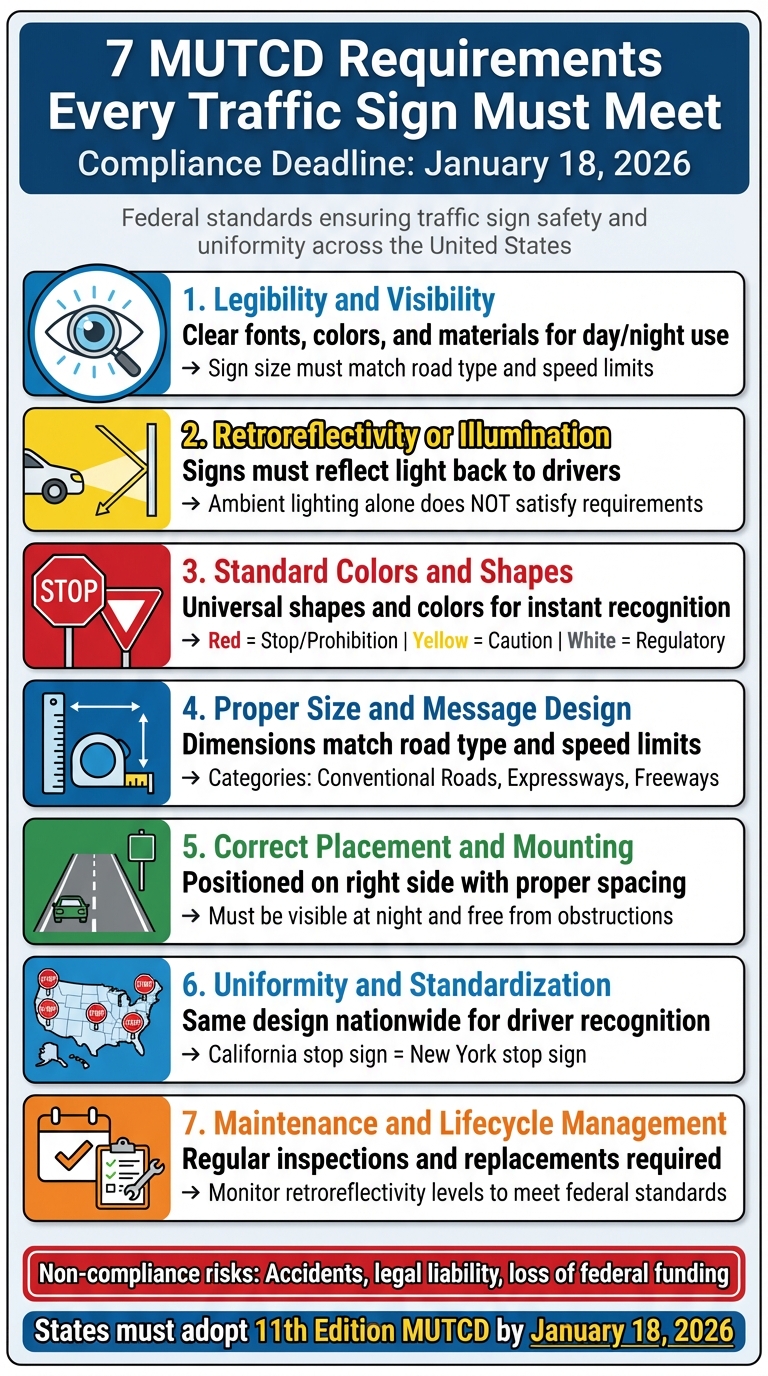
7 MUTCD Requirements for Traffic Sign Compliance
1. Legibility and Visibility
Compliance with MUTCD Standards
The Manual on Uniform Traffic Control Devices (MUTCD) lays out specific guidelines for ensuring that traffic signs are both legible and visible, as detailed in Section 2A.06. Signs must be easy to read and understandable in enough time for drivers to react appropriately. Whether someone is driving 25 mph on a quiet street or 70 mph on a busy interstate, they need to recognize, process, and respond to the sign before passing it.
Uniformity in design - covering aspects like shape, color, size, legends, borders, and retroreflectivity - helps drivers quickly identify signs. For instance, the octagonal shape universally signals a stop sign. These consistent design standards are adapted to suit the specific needs of various types of roadways, as explained below.
Practical Application for Traffic Safety
Sign size should align with road type and speed limits. For high-speed roads, the MUTCD recommends larger signs, such as "Freeway and Expressway" or "Oversized" options, to accommodate increased traffic volumes and the need for greater visibility. On the other hand, "Minimum" sizes are suitable for low-speed roads where smaller legends are still effective. For example, a 30-inch stop sign works well in residential areas but is insufficient for highways with faster-moving traffic.
Legibility also hinges on appropriately sized letters, symbols, and concise messaging to ensure quick understanding. The "Standard Highway Signs and Markings" manual provides precise specifications for approved fonts, symbols, and arrows to maintain consistency. Additionally, incorporating Light Emitting Diode (LED) technology can enhance visibility and readability, as long as the sign’s overall design remains consistent with MUTCD standards.
Adhering to these design principles not only improves immediate readability but also supports the long-term effectiveness and durability of traffic signs.
Durability and Long-Term Performance
Traffic signs must remain clearly visible under all conditions. To meet MUTCD standards, signs are required to be retroreflective or illuminated so they appear the same in both daylight and nighttime conditions. Standard streetlights or highway lighting alone don’t meet these requirements. Instead, the signs themselves must either emit light or reflect it back toward drivers, ensuring consistent visibility regardless of ambient lighting. This ensures that drivers can rely on clear and readable signs, no matter the time of day or weather conditions.
2. Retroreflectivity or Illumination
Compliance with MUTCD Standards
Traffic signs, including regulatory, warning, and guide signs, must be retroreflective or illuminated to maintain their shape and color visibility both day and night. This applies to almost all traffic control devices, such as object markers, unless the Manual on Uniform Traffic Control Devices (MUTCD) explicitly states otherwise.
It's important to note that ambient lighting doesn't satisfy this requirement. The sign itself must either reflect light back to drivers or have its own dedicated light source. Since ambient lighting conditions can vary significantly, relying solely on streetlights may leave some signs - especially in rural areas - insufficiently lit. This standard plays a crucial role in ensuring signs remain effective in real-world driving conditions.
Practical Application for Traffic Safety
Retroreflectivity works by bouncing headlight beams back toward drivers, ensuring signs are visible at night. This increased visibility gives drivers more time to recognize and understand sign information, reducing confusion and encouraging compliance with traffic rules. To maintain these benefits, consistent performance is essential, which is why routine maintenance is so important.
Durability and Long-Term Performance
Over time, retroreflective materials degrade due to weather exposure and general wear and tear. To ensure signs remain effective, agencies must regularly inspect and maintain retroreflectivity at or above required levels. Inspections help identify signs that are damaged, faded, or otherwise compromised, which could impact visibility and safety.
A structured maintenance plan - including cleaning, repairs, or replacements - keeps signage functioning as intended. Documenting these inspections and maintenance activities is critical for regulatory audits and long-term planning. Many agencies now use digital tools to streamline maintenance tracking, ensuring schedules are followed and compliance is maintained in real time.
3. Standard Colors and Shapes
Compliance with MUTCD Standards
The Manual on Uniform Traffic Control Devices (MUTCD) sets specific colors and shapes for traffic signs to ensure drivers can instantly recognize their purpose. Each color and shape carries a universal meaning. For instance, the octagon is reserved exclusively for STOP signs, while a downward-pointing triangle signals yield. The MUTCD also defines precise color guidelines to maintain consistency nationwide: red is used for stop, yield, or prohibition; yellow conveys general caution; white is found on regulatory signs like speed limits; and fluorescent yellow-green marks pedestrian crossings and school zones. These designs are strictly regulated, and road authorities are prohibited from altering them unless explicitly allowed by the MUTCD. This standardization ensures quick recognition, which is essential for maintaining road safety.
Practical Application for Traffic Safety
The use of standardized colors and shapes plays a critical role in helping drivers quickly interpret signs, even at high speeds. This design approach is especially beneficial for individuals who may face language barriers or have vision impairments. For example, a driver who doesn't speak English can still identify a red octagon as a STOP sign or a yellow diamond as a warning. These universal standards ensure that all drivers, regardless of their background or abilities, can recognize and respond to signs effectively. By reducing confusion, these guidelines align with the MUTCD's primary goal: improving safety and clarity for everyone on the road.
Ease of Implementation for Road Authorities
Following MUTCD standards not only enhances road safety but also simplifies the process for road authorities. The clear guidelines make it easier to select and install signs correctly. Authorities can refer to the "Standard Highway Signs and Markings" book for detailed design specifications when implementing new signs. Working with vendors that guarantee MUTCD compliance can further simplify the process and help avoid potential legal issues. Non-compliance can result in legal challenges or loss of funding. Additionally, all new or updated traffic control devices must comply with the latest MUTCD provisions as soon as the new edition is adopted. States are required to adopt the 11th Edition of the National MUTCD as their legal standard within two years of January 18, 2024. This ensures that all road infrastructure aligns with current safety and regulatory standards.
4. Proper Size and Message Design
Compliance with MUTCD Standards
The Manual on Uniform Traffic Control Devices (MUTCD) and the Standard Highway Signs (SHS) book establish strict guidelines for sign dimensions based on road type and speed limit. These guidelines ensure signs are easy to read and deliver their messages promptly. Sizes are categorized for Conventional Roads, Expressways, and Freeways, with both minimum and oversized options outlined. This approach not only meets legal standards but also prioritizes road safety by making signs visible and easy to understand, which is essential for quick decision-making by drivers.
Practical Application for Traffic Safety
Proper message design goes hand-in-hand with legibility standards to ensure drivers can read and react to signs almost instantly. Engineering studies play a key role in determining whether signs should use minimum or oversized dimensions. The goal is to design signs that convey information clearly and quickly, especially in emergencies where drivers rely on reflexes to respond. Poorly designed signs can slow reaction times, so factors like lettering, spacing, and layout must be optimized for immediate comprehension.
Ease of Implementation for Road Authorities
Clear and detailed guidelines make it easier for road authorities to implement these standards effectively. By consulting the SHS book, authorities can quickly identify the correct dimensions for signs across various road types. This resource simplifies compliance and ensures uniformity in traffic control devices nationwide. Properly designed signs not only reduce confusion and the risk of accidents but also promote consistent interpretation of traffic rules. In cases where standard sizes aren’t sufficient, engineering studies can justify custom dimensions to meet specific needs.
5. Correct Placement and Mounting
Compliance with MUTCD Standards
The Manual on Uniform Traffic Control Devices (MUTCD) lays out specific rules for where and how traffic signs should be placed along roadways. According to these guidelines, signs must be installed on the right side of the road to ensure they are easily noticed by drivers. They also need to be spaced appropriately, giving drivers enough time to read and react based on the speed of the roadway. Additionally, signs should be positioned at or near the location where the regulations apply, allowing drivers to see them early enough to take safe and timely action. These standards are designed not just to meet compliance requirements but to enhance driver safety and response.
Practical Application for Traffic Safety
The way traffic signs are placed can significantly affect a driver's ability to react in time. For example, signs located too close to curves or far from intersections may result in delayed recognition and response. To address this, the MUTCD mandates that signs be positioned to ensure maximum visibility at night, avoid obstructions, and remain free from concealment by trees or other environmental factors. This approach ensures drivers receive the visual cues they need precisely when they need them.
Ease of Implementation for Road Authorities
Proper mounting, combined with earlier guidelines on legibility and retroreflectivity, ensures traffic signs are fully effective. Road authorities can simplify compliance by adhering to the MUTCD's placement rules. This involves ensuring signs are visible and readable from a driver's perspective by considering factors like sight lines, road design, and potential obstructions during the planning process. If additional signs are needed, they should enhance clarity rather than create confusion. The 11th Edition of the MUTCD, which becomes the national standard on January 18, 2024, outlines the latest requirements for all traffic control devices.
sbb-itb-5d58da3
6. Uniformity and Standardization
Compliance with MUTCD Standards
The Manual on Uniform Traffic Control Devices (MUTCD) sets the national rules for traffic control devices like road markings, highway signs, and traffic signals used across the country. By law, states must adopt the 11th Edition of the National MUTCD as their official standard within two years of its effective date, January 18, 2024, meaning full compliance is required by January 18, 2026. These standards apply to all public roads, highways, bikeways, and even private roads that are open to public use.
The MUTCD doesn't just cover general guidelines - it specifies every detail of sign design, including shape, color, size, and placement. For instance, a stop sign in California has to look and function exactly like a stop sign in New York. This level of consistency ensures that drivers can easily recognize and understand traffic control devices no matter where they are, reducing confusion and making navigation smoother.
Practical Application for Traffic Safety
Standardized traffic signs are designed to offer instant recognition for drivers. When every sign adheres to the same design principles, drivers can process the information quickly and make safer choices on the road. This is especially important in unfamiliar areas, where drivers rely on predictable signage to guide them.
In emergency situations or when traveling through new regions, this uniformity becomes even more crucial. Drivers can focus their attention on road conditions or hazards rather than struggling to interpret unfamiliar or inconsistent signage.
Ease of Implementation for Road Authorities
For road authorities, following national standards simplifies the process of selecting and installing traffic signs. While the MUTCD lays out detailed guidelines, it also allows for the use of engineering judgment and studies to tailor sign placement and types to specific local traffic needs. This flexibility ensures that unique local conditions are addressed without compromising the overall consistency of the system. The goal is to use standardized signs that meet real safety needs and deliver clear, straightforward messages to drivers.
7. Maintenance and Lifecycle Management
Compliance with MUTCD Standards
To keep traffic signs effective and compliant, agencies must routinely monitor and replace them to meet the minimum retroreflectivity levels outlined by federal standards. These standards, set by the Manual on Uniform Traffic Control Devices (MUTCD), are non-negotiable for road authorities, forming the backbone of all maintenance efforts.
Failing to comply with these requirements can have serious consequences. Not only could agencies risk losing federal funding, but they also face increased liability. Deteriorated or faded signs make it harder for drivers to notice and interpret them, which can lead to more accidents.
Practical Application for Traffic Safety
Maintaining traffic sign visibility and effectiveness requires a systematic approach. Agencies need to identify and replace signs that no longer meet retroreflectivity standards. To achieve this, the Federal Highway Administration (FHWA) suggests several methods, including:
- Conducting nighttime visual inspections.
- Using specialized equipment to measure retroreflectivity.
- Tracking each sign’s lifespan.
- Scheduling regular sign replacements.
- Monitoring a representative sample of signs.
It's important to note that compliance doesn’t mean every single sign must always meet the minimum retroreflectivity levels at all times. Instead, it means agencies need to have processes in place to monitor sign performance and replace or upgrade signs as necessary. This proactive strategy not only enhances road safety but can also help reduce long-term costs by addressing issues before they escalate.
Signage & the MUTCD
Reflective Sheeting Grades Comparison
The quality of reflective sheeting plays a crucial role in ensuring traffic signs remain visible, especially at night or in low-light conditions. Retroreflectivity is key for visibility, but the grade of sheeting determines just how far away drivers can detect and read signs. To improve performance, many road agencies are shifting from traditional Engineer Grade materials to advanced options like High Intensity Prismatic and Diamond Grade sheeting, which provide better visibility and last longer.
Here’s a quick breakdown: Engineer Grade serves as the starting point, offering basic retroreflectivity. High Intensity Prismatic steps it up with better visibility and durability. At the top, Diamond Grade provides the longest visibility range at night and the best longevity. For added effectiveness on warning signs, fluorescent yellow sheeting enhances visibility in dim lighting.
The MUTCD (Manual on Uniform Traffic Control Devices) sets minimum retroreflectivity standards using ASTM D4956-04 classifications. According to these standards:
- Engineer Grade aligns with Type I.
- High Intensity Prismatic corresponds to Types III or IV.
- Diamond Grade matches Types VIII, IX, or X.
TrafficSafetyHQ uses 3M™ High Intensity Prismatic and Diamond Grade reflective sheeting paired with durable .080" aluminum for their signs. This combination not only meets MUTCD and ASTM D4956 standards but also ensures high performance for modern traffic needs. Plus, these signs come with a 10-year durability guarantee, giving agencies confidence in their long-term reliability.
Conclusion
Following the seven MUTCD requirements is key to creating a safer transportation system. When traffic signs are designed with proper legibility, retroreflectivity, color, size, placement, uniformity, and maintenance in mind, drivers can quickly process critical information. This consistency helps prevent accidents, improves traffic flow, and protects vulnerable road users like pedestrians and road workers. With nearly 5,000 pedestrian fatalities occurring annually in car-pedestrian collisions, compliant signage plays a critical role in reducing these tragic incidents. Beyond safety, adhering to these standards also brings legal and operational benefits.
Staying compliant with MUTCD standards not only saves lives but also shields your organization from financial risks. The Federal Highway Administration clearly states: "The MUTCD is the law governing all traffic control devices. Non-compliance with the MUTCD ultimately can result in the loss of federal-aid funds as well as in a significant increase in tort liability".
Additionally, standardization helps lower capital and maintenance costs by taking advantage of economies of scale. Investing in high-quality, compliant signs upfront reduces the need for early replacements and minimizes ongoing maintenance challenges. This approach not only saves money but also ensures greater operational reliability.
TrafficSafetyHQ provides MUTCD-compliant signs crafted with durable .080" aluminum and 3M™ reflective sheeting. Each sign meets MUTCD and ASTM D4956 standards and is backed by a 10-year durability guarantee. Whether you’re looking for parking signs, speed limit signs, or pedestrian crossing signs, they offer a wide range of options starting at just $10.00. With fast shipping and bulk order discounts available, upgrading your signage has never been easier.
FAQs
What happens if traffic signs don’t meet MUTCD standards?
Failing to meet MUTCD standards can bring about serious problems. These range from legal penalties and heightened liability for road authorities to an increased risk of accidents stemming from driver confusion. Signs that don’t align with these standards might not be properly understood by drivers or recognized by enforcement agencies, creating safety risks and potential regulatory breaches.
Beyond safety concerns, using improper signage can lead to expensive replacements and erode public trust. Following MUTCD guidelines ensures clear communication on the road, improves safety, and helps avoid unnecessary legal or financial setbacks.
What is retroreflectivity, and how does it enhance traffic sign visibility?
Retroreflectivity is what makes traffic signs shine brightly at night, reflecting light from vehicle headlights straight back to the driver. This quality ensures that signs remain visible and readable even in low-light conditions or darkness. By improving nighttime visibility, retroreflectivity helps enhance road safety and supports compliance with MUTCD standards.
Why is it important for traffic signs to have a uniform design?
Consistency in traffic sign design plays a key role in ensuring safety on the road. When signs share uniform shapes, colors, and symbols, drivers can quickly identify and understand their meaning. This reduces confusion and helps prevent accidents by allowing for faster, more accurate responses.
Standardized designs are particularly important in challenging situations, such as driving in unfamiliar areas or navigating through poor visibility conditions like heavy rain, fog, or nighttime darkness. Predictable and clear signage enables drivers to make safer decisions, even in high-pressure or complex traffic environments.