

When choosing reflective materials for traffic signs, the decision comes down to Engineer Grade (EG) and High Intensity Prismatic (HIP) sheeting. Here's what you need to know:
- Engineer Grade (EG) is the basic option, offering visibility up to 500 feet and lasting 5–7 years. It's best for low-risk areas like parking lots and private property.
- High Intensity Prismatic (HIP) is three times brighter, visible up to 1,200 feet, and lasts 10–12 years. It's required for public roads to meet safety standards.
Key Differences:
- Brightness: HIP is 3x brighter than EG.
- Visibility: EG: ~500 feet; HIP: 800–1,200 feet.
- Durability: HIP lasts nearly twice as long as EG.
- Cost: HIP costs more upfront but saves on replacement and labor over time.
Quick Comparison:
| Feature | Engineer Grade (Type I) | High Intensity Prismatic (Type III/IV) |
|---|---|---|
| Brightness | Baseline | 3x brighter |
| Visibility Distance | ~500 feet | 800–1,200 feet |
| Lifespan | 5–7 years | 10–12 years |
| Best Use | Parking lots, private areas | Public roads, regulatory signs |
Conclusion: Use Engineer Grade for non-critical signs in low-traffic areas. For public roads or high-speed zones, High Intensity Prismatic is the safer, long-term choice.
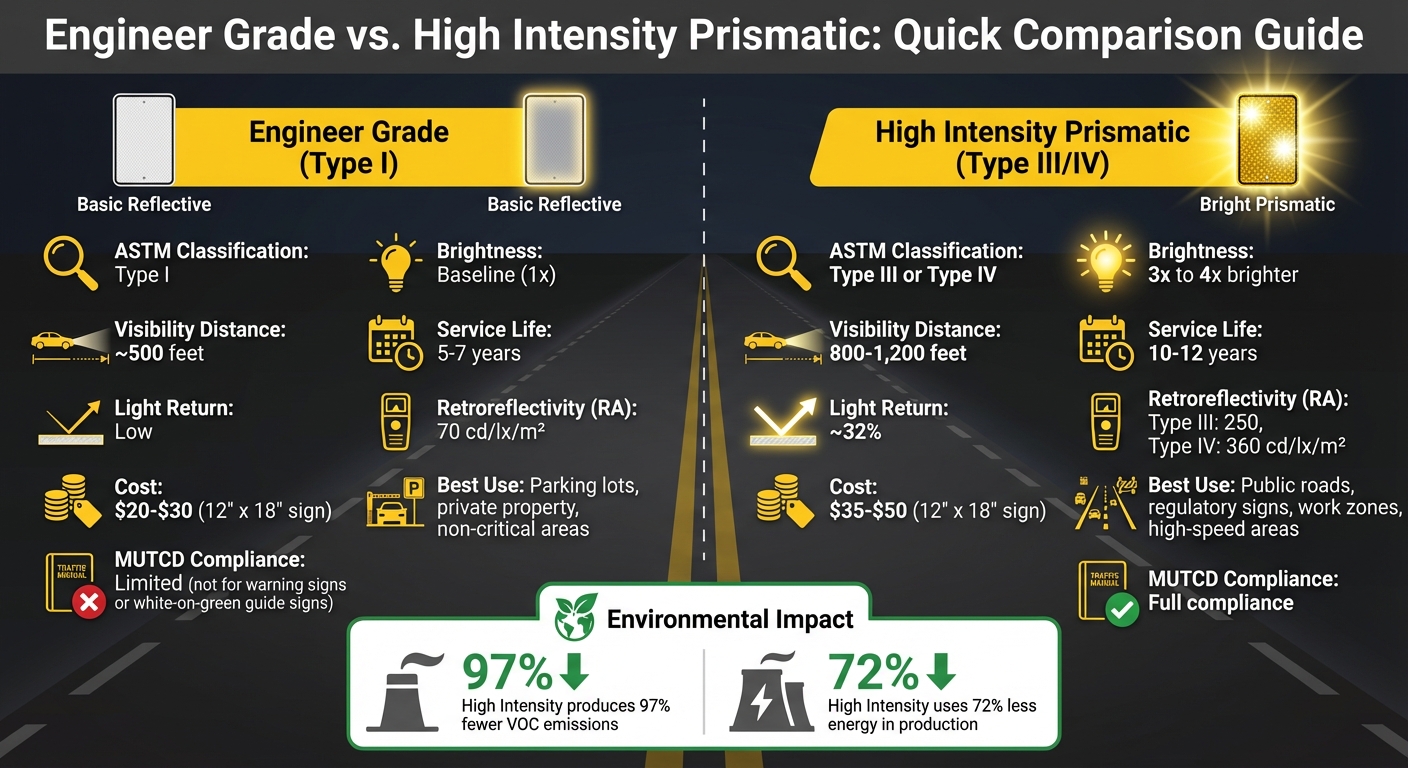
Engineer Grade vs High Intensity Reflective Sheeting Comparison Chart
What Is Engineer Grade Reflective Sheeting?
Engineer Grade Definition and Classification
Engineer Grade (EG) reflective sheeting, known as ASTM D4956 Type I, is the entry-level retroreflective material used for traffic signs. This material uses an enclosed lens system - featuring either glass beads or prismatic optics - to reflect light from vehicle headlights back toward drivers. It includes an acrylic adhesive that ensures a firm bond to sign backings. EG is considered the standard for reflectivity, offering a brightness level rated at 1×. For new white sheeting, the minimum retroreflectivity coefficient (RA) is 70 cd/lx/m². Traffic signs made with EG sheeting are typically visible from about 500 feet away. These characteristics make it a practical option for specific applications, as outlined below.
Common Applications for Engineer Grade
Due to its basic performance level, EG is best suited for areas where high visibility at night or from long distances isn’t essential. Typical uses include parking lot signs, private property markers, and wayfinding signs.
Susan Caldwell from Traffic Safety Suppliers notes, "Type I sheeting has the lowest performance of all Types. Agencies specify it for signs where brightness during nighttime is less critical, such as 'No Parking' signs".
Additionally, EG sheeting is widely used for reflective stickers and decals because it works well with digital printing, screen printing, and vinyl plotters. With a typical lifespan of 5 to 7 years, it provides a budget-friendly option for low-risk applications where cost is a key factor.
Engineer Grade Limitations
While EG sheeting has its uses, it comes with notable limitations. The Federal Highway Administration prohibits its use for warning signs (black-on-yellow) and for white text on green guide signs because it doesn’t meet the retroreflectivity levels required for driver safety. Compared to High Intensity Prismatic sheeting, which offers visibility up to 1,000 feet, EG’s range is significantly shorter. Prolonged UV exposure can also darken the material, making signs nearly invisible in low-light conditions. As a result, many agencies now mandate higher reflectivity grades to meet updated MUTCD standards. Furthermore, producing EG sheeting generates more VOC emissions and consumes more energy than newer High Intensity Prismatic materials, making it less environmentally friendly.
What Is High Intensity Reflective Sheeting?
High Intensity Definition and Classification
High Intensity Prismatic (HIP) sheeting takes reflective technology to the next level, addressing the limitations of Engineer Grade materials. Classified under ASTM D4956 Type III/IV, HIP uses microprismatic lenses with cube-corner reflectors in a two-layer design. This structure includes a pigmented outer layer and a reflective inner layer, which work together to spread light more effectively and improve visibility for drivers. With three times the reflectivity of Engineer Grade, HIP sheeting makes signs visible from 800 to 1,200 feet - double the range of its predecessor, which only reaches 400 to 600 feet. It also reflects approximately 32% of the light it receives and features a durable topcoat that resists scratches and abrasions. These qualities make it a reliable choice for high-demand traffic environments.
Common Applications for High Intensity
HIP sheeting is widely used for permanent public road signs such as regulatory, warning, and guide signs, as well as for work zone devices like barricades, delineators, cones, and barrels. Its high visibility makes it especially effective in areas where safety is critical. Meeting the minimum requirements set by the Department of Transportation (DOT) and the Manual on Uniform Traffic Control Devices (MUTCD), HIP sheeting is a trusted option for high-speed roads, rural areas, and low-light conditions. It comes in all standard traffic colors, including white, yellow, red, orange, blue, green, and brown, ensuring versatility across various traffic applications.
High Intensity Benefits
HIP sheeting stands out for its durability, offering a service life of 10 to 12 years - almost twice as long as Engineer Grade materials. Its production process is also environmentally friendly, producing 97% fewer VOC emissions and consuming 72% less energy compared to Engineer Grade. The material’s wide-angle reflectivity enhances driver safety, especially in areas with indirect lighting or complex traffic patterns. Combined with its compliance with federal retroreflectivity standards, HIP sheeting has become the go-to choice for regulatory and warning signs on public roadways, ensuring both safety and longevity.
What Kind of Reflective Tape is Used on Roads and Highways for Signs?
sbb-itb-5d58da3
Engineer Grade vs. High Intensity: Side-by-Side Comparison
This section breaks down the differences in performance, visibility, and cost to help you decide between Engineer Grade (EG) and High Intensity Prismatic (HIP) reflective materials.
Performance Comparison Table
Here’s a quick look at how these two materials stack up:
| Feature | Engineer Grade (Type I) | High Intensity Prismatic (Type III/IV) |
|---|---|---|
| ASTM D4956 Type | Type I | Type III or Type IV |
| Brightness | Baseline (1x) | 3x to 4x brighter |
| Visibility Distance | ~500 feet | 800 to 1,200 feet |
| Service Life | 5–7 years | 10–12 years |
| Light Return | Low | ~32% |
| MUTCD Compliance | Limited (parking/non-critical only) | Full (public roads/traffic) |
| Durability | Standard; prone to fading | High; scratch and scuff resistant |
| Best Use Case | Parking lots, private property | Public roads, traffic signs, work zones |
The numbers speak for themselves. The minimum coefficient of retroreflectivity (RA) for new white sheeting is a telling metric: Type I measures just 70, while Type III reaches 250, and Type IV goes up to 360. These differences have a direct impact on both safety and long-term costs.
Visibility and Safety Performance
The difference in brightness is not just about aesthetics - it’s about safety. HIP’s 32% light return significantly enhances visibility, giving drivers more reaction time, especially at higher speeds. While Engineer Grade signs are visible from about 500 feet, HIP signs can be seen from 800 to 1,200 feet.
"The reflectivity of a sign greatly impacts how easily a sign can be read." - TrafficSign.com
Let’s put this into perspective: At 55 mph, a vehicle covers roughly 80 feet per second. The additional 300–700 feet of visibility provided by HIP can make all the difference for safe decision-making. The Federal Highway Administration underscores this point: "Type I sheeting material should not be used for warning signs and for the white legend on green background guide signs because it does not provide the retroreflectance level required by the driver".
Beyond visibility, the durability and cost of materials also contribute to overall performance.
Durability and Long-Term Costs
HIP not only outperforms in brightness and visibility but also lasts longer, making it a better investment over time. While HIP signs cost around $35–$50 for a 12" x 18" sign compared to $20–$30 for EG, the need for replacements with EG signs nearly doubles the material and labor expenses.
"A tough topcoat helps signs resist scuffs, scratches and gouges, so your sign is effective for longer, even in extreme climates. That means fewer replacements and associated costs." - Universal Signs and Accessories
HIP also has an edge when it comes to environmental impact. Its production process generates 97% fewer VOC emissions and uses 72% less energy compared to Engineer Grade manufacturing. When you factor in purchase costs, replacement frequency, labor, and environmental considerations, HIP often becomes the more economical choice for permanent installations.
These insights should help you determine the right reflective material for your specific traffic needs.
Which Reflective Material Should You Choose?
Selecting the right reflective material depends on where the sign will be placed and the type of traffic it will encounter. Here’s a breakdown of recommendations based on common sign locations.
Parking Lots and Private Properties
For non-critical signs like "Customer Parking Only," "Reserved Parking," or simple way-finding markers, Engineer Grade is a cost-effective option. In well-lit areas with slow-moving vehicles, it offers sufficient visibility, ranging from 400 to 600 feet.
However, for areas with higher traffic, poorly lit conditions, or regulatory signs like Stop or Yield, upgrading to High Intensity Prismatic is a smart move. With a lifespan of 10 to 12 years, it reduces how often signs need replacing, which can balance out the higher upfront cost. Be sure to check local ASTM D4956 Type requirements before making a choice.
Public Streets and Intersections
When it comes to public roads, the choice is clear: High Intensity is the minimum standard. According to the MUTCD, Engineer Grade doesn’t meet the retroreflectivity requirements for regulatory and warning signs. The Federal Highway Administration (FHWA) emphasizes this point:
"Type I sheeting material should not be used for warning signs and for the white legend on green background guide signs because it does not provide the retroreflectance level required by the driver."
– Federal Highway Administration (FHWA)
High Intensity sheeting provides visibility from 800 to 1,200 feet, ensuring drivers have enough time to react at typical street speeds. For intersections with heavy traffic or higher risks, Diamond Grade is a worthwhile upgrade. It offers enhanced visibility, a 12-year warranty, and better performance in challenging conditions. Keep in mind, the MUTCD does allow some flexibility for non-essential signs, like parking restrictions or bikeway markers, exempting them from strict retroreflectivity maintenance.
Highways, Rural Roads, and Low-Light Areas
On highways and rural roads, where speeds are higher and lighting is minimal, High Intensity is the go-to choice. For even greater visibility, especially in low-light or high-speed zones, Diamond Grade is recommended. At highway speeds, every second matters, and the extended visibility of these materials ensures compliance with MUTCD standards. High Intensity Prismatic is three times brighter than Engineer Grade, offering visibility from 800 to 1,200 feet. Diamond Grade takes it even further, extending visibility to 1,300 to 1,600 feet.
"Retroreflectivity degrades over time, necessitating the need for systematic replacement of signs and work zone devices to maintain the retroreflectivity standards established and required by FHWA."
– Susan Caldwell, Traffic Safety Suppliers
The durability of Diamond Grade, with its 12-year lifespan, makes it ideal for remote or hard-to-reach locations where replacing signs can be both expensive and time-consuming. Engineer Grade should be reserved for private property, as it doesn’t meet the standards required for public roads.
Conclusion
When deciding on reflective materials, Engineer Grade sheeting works well for low-risk, private settings like parking lots or wayfinding signage. It’s a practical and budget-friendly choice, offering a service life of 5 to 7 years, especially for areas with slower traffic and sufficient lighting.
For public roads, intersections, or any location requiring MUTCD compliance, High Intensity Prismatic sheeting is the way to go. It delivers three times the reflectivity of Engineer Grade, ensuring visibility up to 800–1,200 feet, with a lifespan of 10 to 12 years. Plus, its production process is more environmentally friendly, emitting 97% fewer VOCs and using 72% less energy compared to Engineer Grade. This combination of performance and sustainability makes it a smart long-term investment.
For those seeking a complete solution, TrafficSafetyHQ offers a variety of MUTCD-compliant signs made from durable .080" aluminum and paired with 3M™ High Intensity Prismatic or Diamond Grade reflective sheeting. Whether you need regulatory signs for public roads, private parking signage, or custom designs, their products meet FHWA and ASTM D4956 standards and come with a 10-year durability guarantee. Each sign also includes pre-drilled mounting holes for quick and easy installation.
Choosing the right reflective material ensures maximum visibility and safety when it matters most. By aligning the sheeting grade with your specific needs and prioritizing compliance for public roadways, you’re making an investment in quality, safety, and long-term value.
FAQs
What are the environmental impacts of using Engineer Grade vs. High-Intensity Prismatic reflective sheeting?
Engineer Grade (EG) reflective sheeting is a basic option known for its lower reflectivity and shorter lifespan, typically lasting around 5–7 years. This shorter durability means it requires more frequent replacement, which increases waste and adds to the environmental impact of producing, transporting, and installing new materials.
High-Intensity Prismatic (HIP) sheeting, however, stands out with about three times the reflectivity of EG and is built for long-term use. Its extended durability means fewer replacements, leading to reduced waste and a smaller environmental footprint. That said, both EG and HIP use strong adhesives that can be tricky to remove, often requiring heat or solvents. If not managed carefully, this process can pose environmental and safety concerns.
While EG sheeting contributes to more waste due to its limited lifespan, HIP sheeting helps cut down on waste thanks to its durability. Regardless of the material, proper handling and disposal of adhesives are key to minimizing environmental risks.
Why is High Intensity Prismatic sheeting better for public roads compared to Engineer Grade?
High Intensity Prismatic sheeting offers three times more reflectivity compared to Engineer Grade, making signs visible from distances of up to 1,000 feet. In contrast, Engineer Grade signs are typically visible from only 400 to 600 feet. This enhanced visibility is crucial for nighttime driving and areas with low-light conditions, where clear signage can significantly improve safety.
What’s more, High Intensity Prismatic sheeting complies with MUTCD standards for public-road signage, ensuring it meets federal requirements. It’s also built to last, providing greater durability and a longer lifespan. This makes it a smart, cost-effective option, particularly for high-traffic zones like highways and busy roads.
How does the lifespan of reflective materials impact long-term costs?
The durability of reflective materials significantly impacts long-term expenses. Engineer-grade (EG) sheeting has a typical lifespan of 5–7 years, meaning it requires more frequent replacements. Over time, this shorter lifespan leads to higher labor and material costs, making it less economical for extended use.
On the other hand, high-intensity prismatic (HIP) sheeting lasts around 8–10 years. While it comes with a higher upfront cost, its extended lifespan reduces the need for replacements, offering better value over time. Meanwhile, diamond-grade (DG) sheeting stands out with a lifespan of 12 years or more. Its exceptional durability translates to fewer replacements over a 20-year span, resulting in significant long-term savings.
Selecting the appropriate material depends on factors like traffic levels and environmental conditions. Although EG sheeting might appear more affordable initially, materials like HIP and DG often prove to be wiser investments by lowering ongoing maintenance and replacement expenses.