

Traffic sign maintenance is essential for safety, compliance, and reducing liability risks. Property managers often face challenges like vandalism, weather damage, and wear and tear. To ensure traffic signs remain effective, here’s what you need to know:
- Federal Standards: The MUTCD 11th Edition sets national guidelines for traffic signs. Compliance is mandatory for public-access roads by January 2026.
- Inspections: Conduct inspections twice a year, including one at night. Check for damage, fading, retroreflectivity, and obstructions.
- Replacement Priorities: Regulatory signs (e.g., STOP, YIELD) must be repaired or replaced within hours. Warning signs should be addressed within three days.
- Maintenance Tips: Clean signs with mild detergent and avoid abrasive tools. Use durable materials like .080" aluminum and 3M reflective sheeting for longevity.
- Budgeting: Allocate 3% of the original installation cost annually for maintenance. High-quality materials reduce long-term expenses.
- Documentation: Keep detailed records of inspections and repairs to demonstrate compliance and manage liability.
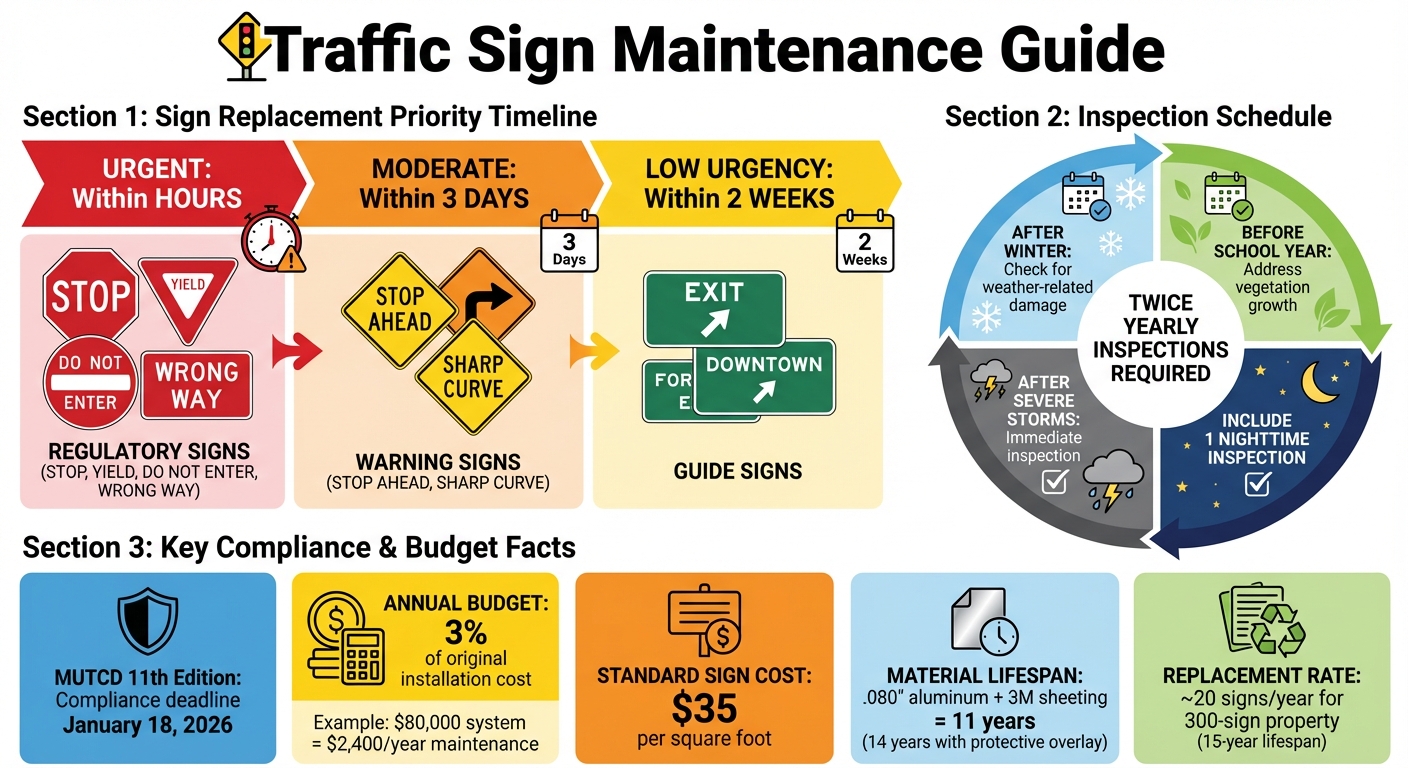
Traffic Sign Maintenance Priority Timeline and Inspection Schedule
Traffic Sign Regulations and Compliance Requirements
What regulations apply to traffic signs on private properties?
The Manual on Uniform Traffic Control Devices (MUTCD) 11th Edition serves as the national standard for traffic control devices across the United States. Published by the Federal Highway Administration (FHWA), it officially took effect on January 18, 2024. States have until January 18, 2026, to adopt it as their legal standard.
The MUTCD applies to all "site roadways open to public travel", which includes private roads that allow public access. However, parking lots and their internal driving aisles generally do not fall under the "open to public travel" category according to federal guidelines. That said, many states require signs in these areas to follow their state-specific manual standards.
To ensure drivers can quickly recognize signs, they must meet specific requirements for shape, color, and size. For instance, a red octagon always signifies STOP, while yellow diamonds warn of hazards. Additionally, signs must be either retroreflective or illuminated to remain visible during both daytime and nighttime.
The FHWA emphasizes that failure to comply with MUTCD standards could expose agencies - and by extension, private property owners managing public-access roads - to potential tort liability. This makes it essential for property owners to understand and adhere to these regulations.
How can property managers verify their signs meet compliance standards?
Begin by consulting your state’s traffic sign standards. While the MUTCD sets federal guidelines, 22 states use supplements, and 10 states have developed their own versions. Your state’s transportation agency or Local Technology Assistance Program (LTAP) can help clarify which rules apply to your property.
To check retroreflectivity compliance, the MUTCD outlines five approved maintenance methods: Visual Nighttime Inspection, Measured Retroreflectivity, Expected Sign Life, Blanket Replacement, or Control Signs. A visual nighttime inspection is a practical starting point. For a more precise evaluation, you can use a retroreflectometer, though these devices can cost around $10,000.
Ensure signs meet MUTCD standards for physical features like size, shape, and mounting height. For example, STOP signs (R1-1) must follow specific dimensions, and on roads with speed limits of 50 mph or higher, sign supports must meet crashworthiness requirements. Also, keep signs free from obstructions like vegetation and make sure they are clean to maintain their visibility and effectiveness.
If a sign is outdated or damaged, it’s important to replace it with one that meets current standards rather than replicating an older, non-compliant design.
When should damaged or outdated signs be replaced?
Regular inspections are key to identifying signs that need immediate attention.
Replace any sign that no longer meets minimum retroreflectivity standards, as it has reached the end of its service life. A sign that looks fine during the day might fail to perform at night if its retroreflective coating has worn off.
Physically damaged, faded, or vandalized signs should be replaced as soon as possible to minimize safety risks.
While there’s no federal deadline for replacing all outdated signs at once, prioritizing replacements based on traffic volume and safety importance is a smart approach.
Keep detailed inspection and maintenance records. According to the FHWA, "having a record of the inspection and repairs is critical to a successful sign management system and will be a valuable asset for your risk management program and tort defense". These records not only demonstrate compliance but can also serve as crucial evidence in liability cases.
Inspection and Maintenance Schedules
How often should traffic signs be inspected?
Traffic signs should be inspected twice a year, with one of those inspections taking place at night to check for legibility and retroreflectivity. As the Federal Highway Administration explains, "While a sign may appear adequate during the day, it may be non-visible at night".
Plan inspections strategically: one after winter to identify weather-related damage and another before the school year to address vegetation growth from the summer. Additionally, always conduct inspections immediately after severe storms or strong winds.
Encourage maintenance staff to report obscured or damaged signs whenever they notice them during routine travel on the property. This ongoing awareness can help address issues between scheduled inspections. For formal inspections, use a two-person team - one person drives while the other takes notes - to ensure safety and thorough documentation.
Next, let’s break down what to focus on during these inspections.
What should property managers look for during inspections?
During inspections, ensure that signs are clear and readable from the required distance, both during the day and at night. Check that their colors and shapes remain consistent, and look for any cracking, peeling, fading, or vandalism on the sign face. Confirm that signs are properly positioned and structurally sound, including having secure posts and functioning breakaway supports.
"All signs, including supports, should be inspected twice a year for: position, damage, legibility, obvious indications of structural distress or failure, [and] general condition."
– TxDOT Manual
Equip technicians with basic tools and spare parts so they can fix minor issues during the inspection. Add dating stickers to the back of signs to track their age and include a contact number for tenants to report damage. Maintain a digital inventory that logs sign locations, sheeting types, and installation dates - this will make it easier to predict when signs might need replacement.
What is the best way to clean and maintain traffic signs?
Clean traffic signs during inspections using a mild detergent solution with a soft cloth or sponge. Rinse with water and let them air dry. Avoid abrasive tools, high-pressure washers, or harsh chemicals, as these can damage the retroreflective coating. Never use solvents, gasoline, or ammonia-based cleaners, as they can weaken the adhesive bond between the sheeting and the aluminum substrate.
The TxDOT Manual emphasizes the importance of keeping records: "Documentation of sign inspections is important to a successful sign program. Sign inspectors should fill out an inspection report for each inspection run". A thorough report should include the date, areas checked, findings, immediate actions taken, and any follow-up actions required. Proper documentation not only ensures accountability but also helps streamline future maintenance efforts.
Repair and Replacement Options
When should you repair a sign instead of replacing it?
Sometimes, a simple repair is all you need. Minor bends, for instance, can often be fixed on-site. You can remove the sign, lay it flat on a smooth surface like a truck bed, and gently tap it back into shape using a rubber mallet with protective padding.
However, when retroreflective sheeting shows splits, peeling, or breaks, replacing the sign is usually the better option. Repairs in such cases can compromise nighttime visibility, which is critical for safety. Property managers should also consider whether the labor costs of repairing the sign outweigh the cost of purchasing a new one.
For small bullet holes, you can flatten the metal and patch the damage with matching retroreflective sheeting. Be sure to seal the back with aluminum foil tape, overlapping at least ½ inch in a shingle pattern (bottom to top) to keep moisture away from the adhesive. If gunshot damage is extensive enough to make the sign unreadable or ineffective at night, replacement is the safer choice.
These repair tips are a good starting point, but choosing the right materials can make a big difference in how long your signs last.
What materials and hardware ensure long-lasting traffic signs?
Durability starts with the right materials. For heavy-duty, rustproof signs, .080" gauge aluminum (5052-H38 alloy) is the go-to option. This aluminum is often pre-treated with a chromate conversion coating to ensure the reflective sheeting adheres properly. For visibility that holds up over time, 3M reflective sheeting with fade-resistant inks is a reliable choice, offering a lifespan of about 7 years. Want to extend that? Apply a 3M Protective Overlay Film (POF) to shield the sign from UV rays, harsh weather, and graffiti, potentially doubling its lifespan to around 14 years.
When it comes to mounting, galvanized U-channel posts ($68.95 for a 6-foot post) offer superior corrosion resistance compared to standard green-painted posts ($46.95 for 6 feet). This makes them an ideal choice for areas with high moisture or coastal conditions. To deter theft, consider using vandal-resistant fasteners like fluted nuts, star bolts, or shear-off heads, which cost about $4.95 per pair (compared to $2.95 for standard fasteners). In high-risk areas, hammering down excess threads on standard bolts can also help prevent unauthorized removal.
How should property managers handle vandalized or stolen signs?
"A sign technician should not leave a sign down or take a damaged sign away and leave nothing in its place."
Safety and compliance come first. If a sign is vandalized or stolen, a temporary or permanent replacement should be installed immediately. This ensures the area remains safe and meets necessary standards.
For vandalized signs, clean them with non-abrasive cleaners. If the retroreflectivity is compromised, replace the sign to maintain its effectiveness. In areas prone to vandalism, protective overlays can simplify maintenance while preserving the sign’s functionality.
To discourage theft, use tamper-resistant fasteners and mark each sign with a unique serial number for tracking and recovery purposes. Adding lighting or surveillance in vulnerable areas can also help deter both theft and vandalism, keeping your signs - and the areas they protect - secure.
sbb-itb-5d58da3
Budgeting for Traffic Sign Maintenance
How can property managers prioritize sign maintenance on a budget?
When working within a tight budget, it’s essential to prioritize maintenance based on the importance of each sign. Regulatory signs like STOP, YIELD, DO NOT ENTER, and WRONG WAY should be repaired or replaced immediately - ideally within hours. Warning signs, such as STOP AHEAD or SHARP CURVE, should be addressed within three days. Guide signs, which are less urgent, can typically wait up to two weeks for maintenance.
Regular cleaning is another cost-effective way to extend the lifespan of traffic signs. Clean signs maintain their retroreflectivity, ensuring visibility while helping you avoid premature replacements. Following this prioritization system will help you allocate resources effectively and keep your budget on track.
What are the typical costs for traffic sign maintenance and replacement?
A good rule of thumb is to set aside about 3% of the original installation cost annually for maintenance. For instance, if your traffic sign system initially cost $80,000, you’d need approximately $2,400 each year for routine upkeep. This budget would cover tasks like cleaning, inspections, minor repairs, and planned replacements.
The cost of replacing individual signs varies depending on their type and size. Standard signs generally cost about $35 per square foot, while specialized components, like LED replacement bulbs, can run around $150 each. For a property with 300 traffic signs and a typical 15-year lifespan, you’d likely need to replace around 20 signs annually to keep the system fully functional. Replacement costs include not just the sign face but also labor, mounting hardware, and any specialized tools - such as bucket trucks - required for installation. Material quality also plays a big role in managing long-term expenses.
How can better materials reduce maintenance costs over time?
Investing in high-quality materials can significantly cut down on maintenance and replacement costs over the long haul. For example, protective overlays allow graffiti and spray paint to be cleaned off easily, saving you from having to replace vandalized signs entirely - especially in areas prone to such damage.
"It is often cheaper to replace a badly damaged or unreadable sign than attempt many repairs in the field." - Federal Highway Administration
Signs constructed from .080" aluminum paired with 3M™ reflective sheeting typically last around 11 years. Adding a protective overlay can extend their lifespan to roughly 14 years. While these materials may have a higher upfront cost, they reduce the need for frequent, labor-intensive repairs and replacements, leading to significant savings over time. Additionally, durable materials often come with robust manufacturer warranties, offering peace of mind if a sign fails prematurely. High-quality aluminum substrates can also be recycled and reused as sign blanks, further lowering future material costs while supporting sustainability efforts.
What Are The Regulations For Traffic Sign Maintenance? - CountyOffice.org
Conclusion
Maintaining traffic signs isn't just about keeping things in order - it’s about ensuring safety, staying compliant, and reducing liability risks. To achieve this, focus on a few key practices: track your inventory, conduct regular inspections, perform preventive maintenance, address repairs or replacements promptly, and keep thorough records of everything. These steps work together to create a maintenance system that’s both efficient and reliable.
When it comes to repairs, prioritize regulatory signs immediately, handle warning signs within three days, and aim to maintain guide signs within two weeks. Plan formal inspections at least twice a year - once after winter and again before the school year starts. Don’t forget nighttime reviews, as signs that look fine during the day might be hard to spot at night.
Detailed recordkeeping is essential. Document inspections, repairs, and ensure staff report any sign issues as soon as they notice them.
Lastly, invest in quality materials like .080-inch aluminum and 3M™ reflective sheeting. These materials not only extend the life of your signs but also save money on maintenance over time. By using durable materials and following a structured approach, you’ll build a maintenance system that’s cost-effective and dependable.
FAQs
What happens if traffic signs on my property don’t meet MUTCD standards?
Failing to follow MUTCD standards can have serious repercussions. These might include higher liability risks and even legal action if an accident happens on your property. On top of that, local or state regulations may impose fines or penalties for non-compliance.
To steer clear of these problems, make sure all traffic signs on your property meet the necessary guidelines for visibility, placement, and design. Conducting regular inspections and keeping up with proper maintenance can help you stay aligned with the standards and create a safer environment for both drivers and pedestrians.
How can property managers plan and budget for maintaining traffic signs effectively?
To manage traffic sign maintenance costs effectively, start by compiling a detailed inventory of all signs on your property. Include essential details like the type of sign, its location, installation date, and estimated lifespan. This information helps you plan for replacements and estimate future expenses. Make it a habit to conduct routine inspections - ideally twice a year, such as after winter and before the school year starts - and after severe weather events. These inspections can help you catch problems like fading, damage, or vandalism early. Keep a maintenance log to document findings, track repairs, and spot recurring issues over time.
When allocating your budget, divide it into three main categories:
- Preventive maintenance: This includes tasks like cleaning and retro-reflectivity testing, which should account for about 30–40% of your annual budget.
- Repairs and replacements: Set aside 15–20% of your budget for fixes and a contingency fund to handle unexpected events.
- Capital renewal: Reserve funds for full replacements based on the signs' age and condition.
Regularly review your maintenance logs to compare actual expenses with your budget forecasts. Use this data to fine-tune future budgets. Taking this proactive approach not only ensures safety and compliance but also helps you manage costs more effectively over time.
What’s the best way to clean and maintain traffic signs on private property?
To ensure traffic signs remain in good condition, start with regular inspections - ideally twice a year, such as after winter and before the start of the school year. During these checks, look for issues like dirt, fading, damage, or signs of vandalism. Be sure to document everything in a maintenance log for future reference.
When cleaning signs, stick to low-pressure water combined with a soft-bristled brush or mild detergent. Avoid using abrasive tools, high-pressure washers, or harsh chemicals, as these can harm the reflective coating or metal surface. If stains, cracks, or fading don’t improve after cleaning, it’s safer to replace the sign to maintain visibility and effectiveness.
Make cleaning part of a preventive maintenance program. Keep detailed records of inspections, cleaning, and repairs, and train staff to promptly report any issues. For areas prone to vandalism, consider using anti-graffiti coatings and sturdy supports to extend the lifespan of your signs. Regular upkeep not only promotes safety but also ensures compliance with MUTCD standards and reduces liability risks for property managers.