

Private roads require proper traffic signs to ensure safety, regulate flow, and comply with federal standards like the Manual on Uniform Traffic Control Devices (MUTCD). Missing or damaged signs can lead to accidents and liability issues. Below are 10 must-have traffic signs for private roads:
- Stop Sign: Controls intersections; must follow MUTCD R1-1 specs with retroreflective materials.
- Yield Sign: Manages right-of-way; requires triangular R1-2 design.
- Speed Limit Sign: Sets safe speeds; sizes vary by road conditions.
- Do Not Enter Sign: Prevents wrong-way entry; uses R5-1 specifications.
- No Parking Sign: Regulates parking zones; available in symbolic or word-based formats.
- Pedestrian Crossing Sign: Highlights crossing areas; uses W11-2 design with retroreflective sheeting.
- Merge Sign: Alerts drivers to lane merges; follows W4-1 MUTCD standards.
- No Left Turn Sign: Prohibits unsafe turns; adheres to R3-2 guidelines.
- One Way Sign: Directs traffic flow; uses R6-2 rectangular design.
- Private Property Sign: Marks legal boundaries and restricts access.
Each sign must meet MUTCD requirements for size, reflectivity, and placement to remain visible and effective. Using durable materials like .080" aluminum and 3M reflective sheeting ensures long-lasting performance, even in harsh weather. Proper installation - such as height, lateral offset, and placement near intersections - is critical for maximizing visibility and compliance.
For high-quality, compliant signs, consider vendors like TrafficSafetyHQ, offering options starting at $10.15 with a 10-year durability guarantee.
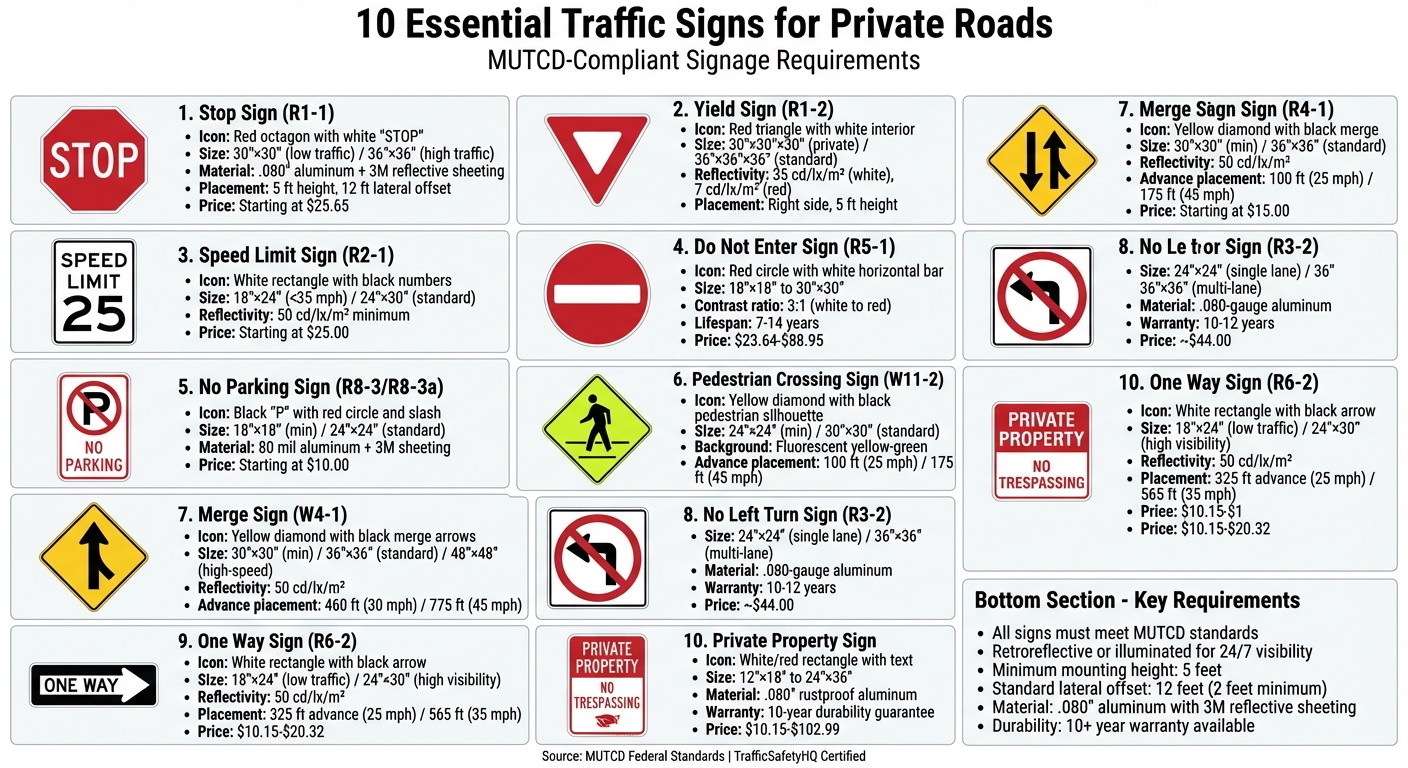
10 Essential Traffic Signs for Private Roads with MUTCD Specifications
Learn Traffic Signs and Their Meanings - Driving Instructor Explains
1. Stop Sign
The octagonal stop sign is one of the most familiar traffic control tools on the road. It signals drivers to come to a full stop, ensuring they yield the right-of-way at intersections where visibility might be limited or traffic flow is unpredictable. On private roads, where controlled intersections are less common, a well-placed stop sign can help prevent accidents and reduce the risk of collisions.
MUTCD Compliance
To adhere to federal MUTCD standards, your stop sign must meet the R1-1 specification - an octagonal design with a white legend and border on a red background. These signs must be retroreflective or illuminated to stay visible at all times, whether it’s day or night. If your road sees fewer than 400 vehicles daily, a 30×30 inch sign will suffice. For roads with heavier traffic or higher speeds, use a 36×36 inch sign. It’s important not to depend solely on street lighting; the sign itself must have retroreflective properties to ensure visibility. Following these guidelines not only keeps you compliant with legal standards but also ensures your signage is effective and durable.
Durability
Choose heavy-duty aluminum for your stop signs since it resists rust and holds up well against harsh weather conditions. Pair this sturdy material with the right reflective sheeting. High-Intensity Prismatic (HIP) sheeting offers excellent reflectivity and comes with a 10-year outdoor warranty, making it a solid choice for most private roads. For areas with more visual distractions or higher-speed traffic, Diamond Grade sheeting provides the best reflectivity and lasts over 12 years. Companies like TrafficSafetyHQ offer MUTCD-compliant stop signs starting at $25.65, featuring .080″ aluminum and 3M™ reflective sheeting.
Proper Placement for Maximum Effectiveness
Position the stop sign on the right side of the road near the intersection, ensuring it remains clearly visible. The bottom edge of the sign should be at least 5 feet above the pavement to align with the driver’s line of sight. Maintain a lateral offset of 12 feet from the road, or at least 2 feet if space is limited, to optimize visibility. If the stop sign isn’t visible from a safe distance, consider adding a "Stop Ahead" (W3-1) warning sign further upstream to give drivers enough time to react.
2. Yield Sign
The triangular yield sign plays a key role in managing right-of-way at intersections. It signals drivers to slow down and yield to oncoming traffic without requiring a full stop. This is especially useful on private roads at merge points, T-intersections, or areas where visibility is limited but a complete stop isn't necessary.
MUTCD Compliance
Understanding the standards set by the Manual on Uniform Traffic Control Devices (MUTCD) highlights why the yield sign is so important. According to the MUTCD, the yield sign must adhere to the R1-2 specification: an equilateral triangle with a red border, a white interior, and the word "YIELD" in red [3, 12].
- Size Requirements: On private roads open to public travel, the minimum size is 30×30×30 inches. For conventional single-lane roads, the standard size increases to 36×36×36 inches [3, 11].
- Visibility Standards: The sign must be retroreflective to ensure visibility during both day and night. The white portion should reflect at least 35 cd/lx/m², while the red portion should reflect at least 7 cd/lx/m².
The MUTCD emphasizes the importance of clear and timely communication, stating:
"The basic requirements of a sign are that it be legible to those for whom it is intended and that it be understandable in time to permit a proper response".
Durability
To withstand harsh weather conditions, yield signs should be made from industrial-grade aluminum. High-quality retroreflective sheeting further enhances durability and ensures the required contrast ratio of 3:1 between the white and red sections for consistent visibility in all lighting conditions.
Proper Placement for Maximum Effectiveness
The effectiveness of a yield sign depends not only on its materials but also on its placement. The sign should be mounted on the right side of the roadway near the intersection [2, 13]. Key placement guidelines include:
- The bottom edge of the sign should be at least 5 feet above the pavement.
- A lateral offset of 12 feet from the roadway is ideal, though 2 feet is acceptable in tighter spaces.
- If visibility is limited, a "Yield Ahead" warning sign should be installed upstream to alert drivers in advance [1, 4, 13].
3. Speed Limit Sign
Speed limit signs are essential for regulating traffic and setting safe driving speeds, even on private roads. According to the R2-1 designation outlined in the Manual on Uniform Traffic Control Devices (MUTCD), these signs must feature a rectangular design with black numbers displayed on a white background. Speed limits are typically shown in 5 mph increments, determined by road conditions and traffic flow.
MUTCD Compliance
The MUTCD specifies that speed limit signs apply to "all private roads open to public travel", including areas like shopping centers, gated communities, and business parks. The standard size for these signs is 24" x 30", but smaller signs measuring 18" x 24" can be used on roads with speeds under 35 mph and low daily traffic volumes (fewer than 400 vehicles). To ensure visibility in all lighting conditions, the signs must meet a minimum retroreflectivity of 50 cd/lx/m² for the white background. Durable materials are key for maintaining these standards over time.
Durability
For long-lasting performance, heavy-duty aluminum paired with 3M reflective sheeting is recommended. This combination resists rust and harsh weather conditions and often comes with a 10-year warranty. Using durable materials reduces replacement costs while ensuring the sign remains visible. For instance, TrafficSafetyHQ offers speed limit signs starting at $25.00, made with .080" aluminum and 3M™ High Intensity Prismatic sheeting for reliable outdoor use.
Proper Placement for Maximum Effectiveness
Once the right materials are selected, proper installation ensures drivers can see and follow the speed limits. Place speed limit signs on the right side of the road, with the bottom edge at least 5 feet above the ground. Maintain a 12-foot lateral offset in open areas or a minimum 2-foot offset in tighter spaces. Additional signs should be installed at every speed change. If the speed drops by more than 10 mph, include a "Reduced Speed Limit Ahead" warning sign further upstream to give drivers enough time to adjust.
4. Do Not Enter Sign
"Do Not Enter" signs play a crucial role in preventing head-on collisions by clearly marking areas where entry is prohibited. These signs are especially important for maintaining safe traffic flow on private roads. Designed according to MUTCD (Manual on Uniform Traffic Control Devices) standards, these R5-1 signs are easy to identify thanks to their bold red circle and white horizontal bar. You’ll often see them placed at the ends of one-way streets, parking lot exits, or near private driveways to discourage unauthorized entry and improve overall safety.
MUTCD Compliance
The Federal Highway Administration (FHWA) emphasizes the importance of proper placement and usage for these signs:
"The DO NOT ENTER (R5-1) sign shall be used where traffic is prohibited from entering a restricted roadway".
Adhering to FHWA guidelines not only ensures compliance but also minimizes liability while enhancing driver recognition. To meet federal safety standards, these signs must maintain a minimum contrast ratio of 3:1 between the white and red retroreflective materials. However, the MUTCD also advises caution:
"Regulatory signs should be used conservatively because these signs, if used to excess, tend to lose their effectiveness".
Durability
Built to last, "Do Not Enter" signs are made from heavy-gauge, rust-resistant (.080 in) aluminum and feature 3M reflective sheeting, such as Engineer Grade or High-Intensity Prismatic, to ensure visibility even at night. Most standard signs are rated for a lifespan of at least 7 years. For additional durability, a 3M Protective Overlay Film can extend their life to 14 years by safeguarding against vandalism . At TrafficSafetyHQ, prices for MUTCD-compliant signs start at $23.64 for an 18" x 18" size, with larger 30" x 30" options available for $88.95.
Proper Placement for Maximum Impact
For these signs to be most effective, they should be installed on the right side of the roadway where drivers are most likely to encounter restricted areas. The bottom edge of the sign should be positioned at least 5 feet above the ground, with a lateral offset of 12 feet. If the sign could confuse drivers not meant to see it, consider shielding or angling it away . In high-risk spots like parking lot exits or sharp curves, pairing a "Do Not Enter" sign with a "Wrong Way" sign provides an additional layer of warning to enhance safety.
Next, we’ll take a closer look at another vital sign for private road safety.
5. No Parking Sign
No Parking signs, much like stop and yield signs, are essential for managing traffic flow and ensuring safety. These signs help regulate where vehicles can be parked, reduce congestion, and keep emergency routes clear. According to the Manual on Uniform Traffic Control Devices (MUTCD), No Parking signs fall under the R7 and R8 series. They come in two formats: the symbolic sign (R8-3), which displays a black "P" crossed out with a red circle and diagonal slash, and the word-based sign (R8-3a), which simply states "NO PARKING." Federal standards ensure uniformity for these signs, even on private roads accessible to the public, like those in shopping centers or residential neighborhoods. These signs work in harmony with other traffic controls to maintain an organized and safe system.
MUTCD Compliance
To comply with MUTCD standards, No Parking signs must adhere to specific guidelines for their shape, color, size, and lettering. On low-volume roads, symbolic signs (R8-3) are typically 24×24 inches, with a minimum size of 18×18 inches. Word message signs (R8-3a) are generally 18×24 inches. All signs must be either retroreflective or illuminated to remain visible during both day and night.
Durability
No Parking signs are built to last. Made from 80 mil reflective aluminum and enhanced with 3M™ sheeting, they can withstand outdoor conditions for over a decade. For even better visibility at night, Diamond Grade reflective sheeting is recommended. Companies like TrafficSafetyHQ offer MUTCD-compliant No Parking signs at competitive prices, starting around $10.00.
Proper Placement for Maximum Effectiveness
To ensure these signs are as effective as possible, they should be installed on the right-hand side of the road with a lateral offset of 12 feet - or at least 2 feet if space is tight. In pedestrian-heavy areas, signs should be mounted 7 feet above the ground, while in rural areas, a 5-foot mounting height is sufficient. For added visibility, consider placing a second sign on the left-hand side or using retroreflective strips on the signpost.
sbb-itb-5d58da3
6. Pedestrian Crossing Sign
Pedestrian crossing signs play a crucial role in ensuring safety for both drivers and pedestrians by clearly marking designated crossing areas on private roads. The W11-2 sign, shaped like a diamond, features a black pedestrian silhouette on a yellow or fluorescent yellow-green background. This simple yet effective design quickly conveys its purpose. On private roads, these signs must adhere to MUTCD guidelines.
MUTCD Compliance
For standard roads, pedestrian crossing signs typically measure 30×30 inches, with a minimum size of 24×24 inches for roads with lower speed limits. The fluorescent yellow-green background enhances visibility, especially in dim lighting. To maintain effectiveness, all pedestrian crossing signs must be retroreflective, ensuring they remain visible at night or in poor weather conditions. The latest standard, outlined in the 11th Edition of the MUTCD (released December 2023), must be implemented by January 18, 2026. These guidelines ensure that the signs meet safety and visibility requirements.
Durability
Pedestrian crossing signs are built to endure outdoor conditions. Typically made from aluminum, they are coated with reflective materials like High Intensity (HI) or Diamond Grade (DG) sheeting to ensure long-lasting performance. TrafficSafetyHQ offers MUTCD-compliant pedestrian crossing signs starting at $15.00. These signs are designed to maintain their retroreflective properties over time, even under harsh conditions.
Proper Placement for Maximum Effectiveness
While compliance and durability are important, correct placement is key to maximizing the sign's effectiveness. Proper positioning allows drivers enough time to react. For instance, on a road with a speed limit of 25 mph, the sign should be installed at least 100 feet before the crossing. On roads with a 45 mph limit, placement should be about 175 feet in advance. Additionally, the signs should be mounted at least 6 feet from the shoulder on rural roads or 2 feet from the curb in urban areas. To avoid confusion, maintain a minimum spacing of 100 feet between signs. Regular evaluations of sign visibility in varying lighting conditions are also recommended.
7. Merge Sign
Merge signs are essential for alerting drivers about upcoming lane merges. The standard Merge sign (W4-1) is designed as a diamond-shaped sign with a black legend and border on a yellow background. This design helps drivers quickly recognize the sign, especially on private roads where traffic patterns can shift unexpectedly. Its main goal is to give drivers an early warning, allowing them to adjust safely to merging situations.
MUTCD Compliance
According to the Manual on Uniform Traffic Control Devices (MUTCD), Merge signs should measure 36×36 inches for conventional roads, with a minimum size of 30×30 inches in low-speed areas. For high-speed private roads, the size increases to 48×48 inches. All Merge signs must follow the diamond shape and be made with retroreflective materials to ensure visibility.
Durability
Merge signs are built using 0.080-inch aluminum and coated with retroreflective materials like beaded or prismatic sheeting. For bold black-on-yellow signs such as the W4-1, the minimum retroreflectivity requirement is 50 cd/lx/m² when prismatic sheeting is used. Companies like TrafficSafetyHQ provide MUTCD-compliant Merge signs made with durable aluminum and 3M™ reflective sheeting, ensuring they perform reliably in outdoor conditions over time.
Proper Placement for Maximum Effectiveness
To maximize effectiveness, Merge signs should be placed to allow drivers approximately 14 seconds to respond. For instance:
- At 30 mph, the sign should be installed about 460 feet before the merge point.
- At 45 mph, the placement should be roughly 775 feet in advance.
On rural roads without shoulders, the sign should be mounted on the right-hand side, 12 feet away from the edge of the traveled way, with the bottom of the sign at least 5 feet above ground level. Additionally, there should be at least 100 feet of spacing between the Merge sign and other traffic signs to maintain clear visibility. Following this, the No Left Turn sign can further enhance traffic control on private roads.
8. No Left Turn Sign
A No Left Turn sign plays a crucial role in preventing unsafe turning maneuvers, especially on busy private roads. The No Left Turn sign (R3-2) is a regulatory sign designed to stop left turns at specific intersections or driveways. Its rectangular design features a black legend and border on a white, retroreflective background, making it easily recognizable even in low-light conditions. On private roads with complex traffic patterns or safety concerns, this sign helps reduce the risk of collisions and traffic bottlenecks.
MUTCD Compliance
The Manual on Uniform Traffic Control Devices (MUTCD) outlines detailed size requirements for No Left Turn signs based on the type of roadway. For single-lane conventional roads, the standard size is 24 inches by 24 inches, while multi-lane roads require a larger 36 inches by 36 inches. On private roads, smaller sizes may be allowed if deemed appropriate by engineering judgment. To ensure visibility day and night, all signs must be retroreflective or illuminated, maintaining their shape and color in varying lighting conditions.
Durability
No Left Turn signs are built to last. They are made from .080-gauge aluminum, which is resistant to rust and cracking even after prolonged outdoor use. The reflective sheeting used on these signs comes in two options: High Intensity Prismatic (HIP), which has a 10-year warranty, and Diamond Grade (DG), offering a 12-year warranty. A standard MUTCD-compliant R3-2 sign in the 24-inch size typically costs around $44.00. To preserve their clarity, the legends and symbols are applied using durable materials like translucent inks, vinyl, or film, which resist fading over time.
Proper Placement for Maximum Effectiveness
For the best results, at least one No Left Turn sign should be installed in one of these strategic locations: over the roadway, at the far left corner of the intersection, on a median, or alongside a STOP or YIELD sign on the near right corner. Signs should be mounted according to standard height and positioning guidelines. In areas where violations are frequent, consider adding a second sign on the left-hand side or enhancing the post with retroreflective materials for greater visibility.
9. One Way Sign
The One Way sign (R6-2) is a regulatory tool designed to guide traffic in a single direction. Its primary purpose is to prevent head-on collisions and minimize confusion, especially on private roads with narrow lanes or limited visibility. This sign is easily recognizable, featuring a black legend and border on a white, retroreflective background, which ensures visibility for drivers day or night. As noted by the United States Department of Transportation, "Damaged or missing regulatory signs (especially the STOP, YIELD, ONE WAY, and DO NOT ENTER signs) should be replaced or repaired within hours of the agency having notice of them". This highlights the critical role these signs play in maintaining safe and orderly traffic flow.
MUTCD Compliance
Like other regulatory signs, One Way signs must meet specific standards outlined in the MUTCD. These signs are rectangular and must maintain a retroreflectivity level of at least 50 cd/lx/m² for the white background. To ensure visibility under all lighting conditions, they must be either retroreflective or illuminated. For private roads with lower traffic volumes, the standard size is typically 18 inches by 24 inches, while larger versions, measuring 24 inches by 30 inches, are used in areas requiring higher visibility.
Durability
One Way signs are built to last, constructed from rustproof, heavy-duty aluminum - usually with a thickness of 80 mil. They are coated with 3M reflective sheeting, such as Engineer Grade or High-Intensity Prismatic, to maintain their visibility over time. Smaller 12×18-inch signs start at $10.15, while professional-grade 18×18-inch options are priced around $20.32. TrafficSafetyHQ provides federally compliant versions made from .080-inch aluminum and 3M™ reflective sheeting, offering a 10-year durability guarantee.
Proper Placement for Maximum Effectiveness
Placement is key to the effectiveness of a One Way sign. Install the sign at the entrance of the roadway where drivers need to make their directional choice. The bottom of the sign should be mounted at least 5 feet above the ground, positioned at the pavement's edge. On rural roads without shoulders, the sign should be placed 12 feet away from the traveled roadway. In more complex driving scenarios, such as those requiring speed adjustments or lane changes, advance placement distances are recommended - 325 feet for speeds of 25 mph and 565 feet for speeds of 35 mph.
10. Private Property Sign
Private Property signs are essential for controlling access and marking legal boundaries on private roads. These signs clearly indicate that a roadway is private and not intended for through traffic. According to the American Sign Company, "When you put Private Road signs out on your property, you are" setting the legal groundwork to address trespassing issues.
MUTCD Compliance
For private roads that are open to public travel, these signs must follow specific standards outlined by the Manual on Uniform Traffic Control Devices (MUTCD). They should be rectangular with standard color schemes, such as black on white or red on white, to ensure they are easily recognized as official traffic signs. This consistency helps align private road signage with broader traffic control measures.
Durability
Private Property signs are designed to endure outdoor conditions. They are typically made from .080-inch rustproof aluminum, ensuring they hold up against weather and wear. Prices vary based on size: basic 12"×18" signs start at $10.15, while larger options like 18"×24" range from $20.32 to $56.23. For even bigger signs, such as 24"×36", costs can reach about $102.99. TrafficSafetyHQ offers federally compliant signs crafted from the same durable aluminum, featuring 3M™ reflective sheeting and a 10-year durability guarantee.
Proper Placement for Maximum Effectiveness
To ensure maximum visibility and effectiveness, place your Private Property sign at the entrance to your private road, typically where it meets a public highway or at the start of your driveway. The sign should be installed on the right side with a lateral offset similar to that used for regulatory signs. This strategic placement gives drivers ample time to react. If you plan to add barriers like fences or gates, check with local authorities and confirm any neighboring easements, as some jurisdictions may restrict blocking access, even on private roads.
Conclusion
Putting up these 10 essential signs isn’t just about following regulations - it’s about creating a safer space for everyone using the road. Regulatory signs like Stop, Yield, and Speed Limit set clear rules for drivers, while warning signs draw attention to potential hazards, such as pedestrian crossings or merging traffic, that might not be immediately obvious. Together, these signs address both the legal requirements and the practical safety needs of private road management.
The success of your signage largely depends on standardization and quality. By using MUTCD-compliant signs, you ensure that drivers can quickly understand and respect the messages, even if they’re unfamiliar with your property. These signs are required to be retroreflective or illuminated, making them visible at all times of day or night. However, it’s worth noting that overusing signs can dilute their overall impact.
Durability is just as critical as compliance. Signs made from high-quality, rustproof .080-inch aluminum with 3M reflective sheeting are built to endure harsh weather conditions for years. This durability reduces the need for frequent replacements, saving both time and money while maintaining safety standards. By combining compliance with long-lasting materials, you ensure a safer and more reliable road system.
TrafficSafetyHQ offers MUTCD-compliant signage designed to meet these needs. Their signs, crafted from .080-inch aluminum with 3M™ reflective sheeting, come with a 10-year durability guarantee. Starting at $10.15 and boasting a 4.8/5-star rating, their products make it easy to fully equip your private road system with reliable, high-quality signs.
FAQs
Why should private roads comply with MUTCD standards?
Complying with the Manual on Uniform Traffic Control Devices (MUTCD) is key to ensuring private roads align with nationally recognized safety and design standards. These standards make traffic signs clear, consistent, and easy to interpret, which helps reduce confusion and accidents - especially for drivers who may be unfamiliar with the area.
The MUTCD provides specific guidelines for designing, placing, and illuminating signs to maximize visibility and safety. For instance, traffic signs are typically placed on the right-hand side of the road, positioned at least 12 feet from the traveled way, and mounted 5 feet above the ground. By following these standards, drivers are better equipped to react promptly and safely to road conditions.
Beyond safety, adhering to MUTCD standards also offers legal protection. Courts and insurance companies often view compliance as proof that reasonable safety measures are in place, which can help property owners avoid liability issues. By meeting these guidelines, private road managers can create safer driving environments while minimizing legal and operational concerns.
What are the best materials for making durable traffic signs for private roads?
For durable traffic signs on private roads, aluminum stands out as the go-to material. Its natural resistance to rust, weather damage, and impacts makes it perfect for outdoor environments. To boost visibility, aluminum signs are typically coated with retroreflective sheeting. This special coating reflects headlights back toward drivers, ensuring the signs are easy to read, whether it’s day or night.
The reflective layer is crafted from materials like micro-prisms or glass beads, both of which align with Federal Highway Administration standards. These are the same tough materials used for public road signs, designed to endure extreme weather and high-traffic conditions while keeping safety and visibility intact.
What is the best way to position traffic signs for clear visibility on private roads?
To make sure traffic signs are easy to spot on private roads, it's important to stick to the recommendations outlined in the Manual on Uniform Traffic Control Devices (MUTCD). Signs should be installed on the right-hand side of the road, positioned at least 12 feet away from the pavement's edge. The bottom of the sign should be placed at a height of at least 5 feet above the ground. Ideally, signs should be located where drivers can see them clearly, several hundred feet before they need to react.
Avoid placing signs where visibility might be obstructed - such as behind trees, poles, or other objects. Also, steer clear of sharp curves or steep slopes that could block a driver's view. To improve visibility, especially at night, use retroreflective materials. On wider roads or in areas with limited sightlines, adding a second sign on the left side can provide extra clarity. These measures ensure drivers have enough time to see, understand, and act on the information the signs provide.