

The Manual on Uniform Traffic Control Devices (MUTCD) sets the national standard for traffic signs used in work zones, ensuring safety for drivers and workers. Here's what you need to know:
- Key Standards: Work zone signs must follow strict rules for color, shape, size, retroreflectivity, and placement. For example, warning signs use black text on an orange background.
- Types of Signs: Temporary signs fall into three categories: Regulatory (e.g., speed limits), Warning (e.g., lane closures), and Guide (e.g., detours).
- Placement Rules: Signs should be spaced based on road type and speed limits. For example, on freeways, the first warning sign should be at least 1,000 feet before the work zone.
- Height and Visibility: Urban signs must be mounted at least 7 feet high, while rural signs require a 5-foot minimum. Retroreflective materials ensure nighttime visibility.
- Crashworthy Supports: All sign supports must meet safety standards to reduce risks during collisions.
- 2025 Updates: The latest MUTCD edition, effective January 2024, includes new requirements for automated vehicles and vulnerable road users.
Compliance with MUTCD guidelines is mandatory to maintain safety and minimize liability. Proper sign placement, visibility, and maintenance are key to ensuring smooth traffic flow in and around work zones.
Work Zone Warning Signs, Traffic Control & The MUTCD - FREE Certification
Types of Work Zone Signs and When to Use Them
Knowing the different types of work zone signs is crucial for proper placement and spacing. According to the MUTCD, there are three main categories of temporary traffic control signs: Regulatory, Warning, and Guide. Each serves a specific purpose in directing drivers and protecting work areas.
Regulatory signs communicate traffic laws or rules that apply within the work zone. These signs are usually rectangular with black text on a white background. Examples include ROAD CLOSED (R11-2) and SPEED LIMIT (R2-1) signs. If the work zone requires changes to the usual roadway rules, existing signs should be covered or removed and replaced with temporary regulatory signs.
Warning signs alert drivers to conditions or situations they might not notice immediately. These signs are diamond-shaped with black text on an orange background, typically measuring at least 48 x 48 inches on freeways and expressways. Examples include ROAD WORK AHEAD (W20-1), FLAGGER (W20-7a), and LANE CLOSED (W20-5) signs.
Guide signs provide directional information to help drivers navigate the work zone, such as route changes, destinations, or distances. These signs use black text on an orange background and include markers like DETOUR (M4-9) and END ROAD WORK (G20-2).
These categories lay the groundwork for the placement and spacing guidelines discussed in the following sections.
Advance Warning Signs
Advance warning signs give drivers a heads-up about upcoming work zone restrictions or changes, allowing them to react in time. For example, the W20-1 "ROAD WORK AHEAD" sign is a general alert that should be placed before the work area or any detour.
Use the DETOUR (W20-2) sign to prepare drivers for a route change. The ONE LANE ROAD sign (W20-4) is necessary where two-way traffic must share a single lane. Similarly, the LANE(S) CLOSED signs (W20-5, W20-5a) warn of lane closures on multi-lane roads.
Placement distances depend on the type of road. On low-speed urban streets, the nearest warning sign should be about 100 feet from the work zone. On freeways and expressways, the distance increases to 1,000 feet or more. Portable Changeable Message Signs (PCMS) should be visible from at least 0.5 miles (800 meters), day or night.
The FLAGGER sign (W20-7) must be installed ahead of any flagger station and removed or covered when flagging is not in progress. The SHOULDER WORK sign (W21-5) is used to warn of maintenance or utility work on the shoulder, provided the main roadway remains clear.
Regulatory Signs for Work Zones
Regulatory signs enforce traffic laws and signal legal requirements in work zones. For instance, the ROAD CLOSED sign (R11-2) is used when a roadway is entirely closed to public traffic, except for authorized vehicles or contractors' equipment. This sign is often mounted on a Type III Barricade. LOCAL TRAFFIC ONLY signs (R11-3a, R11-4) are used to limit access to local vehicles before a closure.
In multi-lane work zones, the STAY IN LANE sign (R4-9) directs traffic to remain in specific lanes. Speed reduction signs (R2-10, R2-12) are also commonly used to enforce temporary speed limits.
To emphasize safety, BEGIN HIGHER FINES ZONE signs (R2-10) should be placed at the start of zones with increased penalties, with END signs (R2-11) marking their conclusion. These signs remind drivers of the heightened consequences for violations in areas where workers are present.
Portable signs are generally used for short durations (three days or less), though some, like the R9 or R11 series, may remain longer. In rural areas, signs should be mounted at least 5 feet above the pavement, while in areas with pedestrians or parking, the minimum height is 7 feet.
Termination Signs
Termination signs mark the end of the work zone and signal a return to normal road conditions. The END ROAD WORK sign (G20-2) is placed near the termination area, using a horizontal rectangular design with black text on an orange background.
These signs let drivers know that work zone restrictions no longer apply and normal traffic patterns can resume. Warning signs must be promptly removed or covered once the hazard or condition they describe is no longer present.
The END HIGHER FINES ZONE sign indicates the conclusion of increased penalty areas. Together, regulatory and termination signs create a complete system that guides drivers through the work zone and back to regular traffic conditions.
Sign Placement and Spacing Requirements
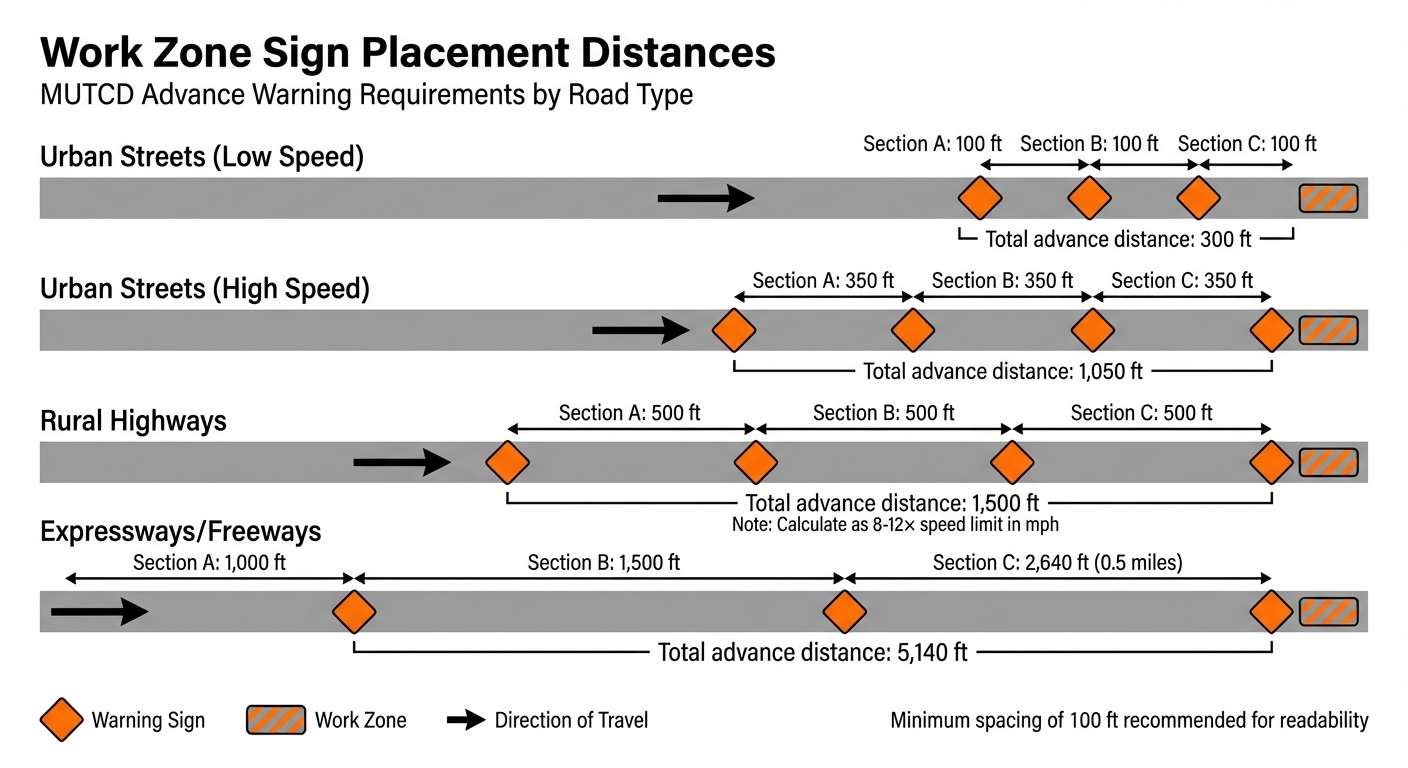
MUTCD Work Zone Sign Placement Distances by Road Type
Getting sign placement and spacing right is crucial for ensuring drivers can quickly read and respond to work zone warnings. The MUTCD breaks the advance warning area into three sections: A, B, and C. Here’s how they work: A is the distance from the work zone to the first sign, B is the gap between the first and second signs, and C is the gap between the second and third signs.
Typically, signs are placed on the right-hand side of the road. To boost visibility, signs can also be positioned on both sides of the road. This setup ensures drivers have enough time to notice, understand, and act on the information provided, allowing for proper Perception-Response Time (PRT).
Advance Warning Distances
Advance warning distances vary depending on the road type and speed limits. For urban streets, the spacing ranges from 100 feet on low-speed roads to 350 feet on high-speed roads.
On rural highways, the first sign should be placed 8 to 12 times the speed limit (in mph) before the work zone. For instance, a rural road with a 55 mph speed limit requires the first sign to be 440 to 660 feet ahead of the work zone.
On freeways and expressways, the spacing is even greater. Signs should be placed at distances of 1,000 feet, 1,500 feet, and up to 2,640 feet (0.5 miles) or more, depending on the speed and traffic conditions. These extended distances are critical for giving drivers enough time to adjust their speed or change lanes safely.
| Road Type | Distance A | Distance B | Distance C |
|---|---|---|---|
| Urban (low speed) | 100 ft | 100 ft | 100 ft |
| Urban (high speed) | 350 ft | 350 ft | 350 ft |
| Rural | 500 ft | 500 ft | 500 ft |
| Expressway/Freeway | 1,000 ft | 1,500 ft | 2,640 ft |
These distances are especially important in areas with limited visibility or obstructions. In such cases, spacing should be increased to ensure drivers have ample time to react. A minimum spacing of 100 feet is recommended to maintain readability.
Height and Positioning Rules
Sign height and positioning also play a big role in visibility and comprehension. In rural areas, signs should be mounted at least 5 feet above the pavement, measured from the bottom edge of the sign.
In urban areas, such as business or residential zones, the minimum height increases to 7 feet. This measurement is taken from the bottom of the sign to the top of the curb or the edge of the traveled way. For signs installed above sidewalks, there must be at least 7 feet of vertical clearance from the bottom of the sign to the sidewalk.
If a secondary sign is placed below a primary one, it can be mounted 1 foot lower than the standard height - for example, 4 feet in rural areas or 6 feet in urban settings. For larger signs (over 50 square feet) mounted on multiple breakaway posts, the bottom edge should be at least 7 feet above the ground.
When signs are mounted on barricades or portable supports, the bottom edge must be at least 1 foot above the traveled way. All supports, whether portable or fixed, must meet crashworthy standards to ensure driver safety.
Mounting Options
Portable sign supports are a flexible option for temporary setups, especially for work zones lasting 3 days or less. However, certain regulatory and warning signs (like the R11 or W1 series) are not subject to this time limit.
For mobile work zones, signs can be mounted on work vehicles, shadow vehicles, or trailers. This method is ideal for projects where the work zone shifts throughout the day.
When using Type 3 Barricades, ensure the sign doesn’t cover more than 50% of the top two rails or 33% of the total area of all three rails. This maintains the barricade’s visibility. Sign supports should never obstruct sidewalks or bike lanes. If a sign must extend into a pedestrian area, it should not project more than 4 inches if mounted lower than 7 feet.
sbb-itb-5d58da3
Visibility, Reflectivity, and Material Standards
The MUTCD sets clear requirements for work zone signs to ensure they remain visible, durable, and effective under all conditions. These standards cover retroreflectivity and crashworthy support to maintain safety and performance.
Minimum Visibility Distances
Sign placement is determined by legibility distances outlined by the MUTCD. For most condition-warning signs, this distance is 180 feet. For alignment warning signs, like those indicating curves or turns, the required distance increases to 250 feet.
On a roadway with a 75 mph speed limit, signs must be positioned 1,350 feet ahead in heavy traffic conditions. If a warning sign includes more than four words or uses legends smaller than 6 inches, an additional 100 feet should be added to the advance placement distance.
Retroreflectivity Standards
Work zone signs used at night must either be retroreflective or illuminated. Retroreflectivity ensures signs are visible in vehicle headlights by reflecting light back toward the driver.
"The ability of a sign to fulfill its role during nighttime periods is provided by a unique form of reflection known as 'retroreflectivity.'" - Michael F. Trentacoste, Director, Office of Safety Research and Development
To meet retroreflectivity standards, signs must use materials with a smooth, sealed outer surface. Approved reflective sheeting, such as 3M™, or dedicated illumination systems are required. Fluorescent colors like orange, red-orange, or yellow-orange are recommended for better visibility during twilight hours.
Over time, retroreflectivity can degrade due to sunlight, weather, and grime. To ensure effectiveness, agencies need to inspect signs both during the day and at night, replacing any that fall below the minimum retroreflectivity levels.
Crashworthy Support Specifications
Sign supports in work zones must meet crashworthy standards, meaning they’ve passed safety evaluations like those in NCHRP Report 350 or the AASHTO Roadside Design Guide. These supports are designed to give way upon impact, reducing the risk of injury to drivers and workers.
Rigid signs must use .080-inch aluminum to meet crashworthiness requirements. Flexible roll-up signs often include features like polycarbonate corner pockets, anti-kiting straps, and heavy-duty rib kits to maintain stability in windy conditions. On freeways and expressways, diamond-shaped warning signs should measure at least 48 x 48 inches for proper visibility at higher speeds.
Unshielded sign posts located within the clear zone should be designed to yield upon impact, minimizing potential hazards.
2025 MUTCD Updates and 11th Edition Changes
The 11th Edition of the MUTCD, which goes into effect on January 18, 2024, introduces updated guidelines for work zone traffic control. States are required to adopt these changes by January 18, 2026.
One major update in Part 5 focuses on automated vehicles, ensuring that work zones are designed to be both machine-readable and accessible for human drivers.
This edition also strengthens provisions for vulnerable road users (VRUs), such as pedestrians, bicyclists, and individuals with accessibility needs. Work zone planners must now account for how non-motorized users navigate through construction areas, not just vehicles. These updates build on existing standards for sign placement and performance, addressing the evolving needs of users and the integration of new technologies.
On August 29, 2025, the FHWA unveiled its fifth phase, introducing updated design specifications and vector graphics for 104 guide and emergency signs. These updates will lead to a new edition of the Standard Highway Signs publication, fully aligned with the 11th Edition.
Additionally, the HTML companion format of the manual has been discontinued. Starting in October 2024, the manual will be available exclusively as an official PDF with navigational hotlinks.
Conclusion
Work zone signage plays a critical role in protecting workers, safeguarding drivers, and minimizing liability risks. According to the MUTCD, all traffic control devices used for construction, maintenance, or utility work on streets, highways, or private roads open to public travel must meet its provisions. Ensuring compliance with these national requirements is a key responsibility for maintenance personnel.
MUTCD standards emphasize the importance of proper placement, retroreflectivity, and crashworthy performance. For nighttime use, signs must either be retroreflective with a smooth, sealed surface or illuminated to maintain their daytime appearance in terms of shape and color. Additionally, all work zone hardware, including signs and supports, must meet crashworthiness criteria such as NCHRP Report 350 or MASH standards to ensure safety in the event of an impact.
Compliance doesn’t end with installation - it requires ongoing maintenance. Regular inspections and timely replacements are essential to ensure signs remain legible and correctly positioned. For example, signs like "Flagger Ahead" should be covered or removed when the operation is inactive, preventing unnecessary driver confusion.
The Federal Highway Administration underscores the importance of clear and effective traffic control, stating:
"Traffic control in temporary traffic control zones should be designed on the assumption that road users will only reduce their speeds if they clearly perceive a need to do so".
To meet this standard, signage must be visible, easy to understand, and spaced correctly in accordance with MUTCD guidelines.
TrafficSafetyHQ offers work zone signs crafted from durable .080" aluminum and 3M™ reflective sheeting, designed to meet MUTCD and ASTM standards. These signs ensure long-lasting outdoor performance while maintaining regulatory compliance. Following these MUTCD guidelines not only meets legal requirements but also promotes the highest levels of traffic safety.
FAQs
What are the current MUTCD guidelines for self-driving vehicles in work zones?
Currently, the MUTCD doesn't offer specific guidelines tailored to self-driving or automated vehicles operating in work zones. The most recent updates, including the 11th Edition, continue to focus on general temporary traffic control standards, such as where to place signs and ensuring they are visible.
For the latest details on how connected and automated vehicles (CAVs) should handle work zones, it's best to consult documentation from the Federal Highway Administration (FHWA) or look for recent guidance that directly addresses this area.
Why is retroreflectivity important for work zone signs at night?
Retroreflectivity plays a key role in making work zone signs visible to drivers at night. By reflecting light from vehicle headlights back toward the driver, retroreflective sheeting ensures that signs are easy to spot from a distance. Advanced materials like High-Intensity Prismatic (HIP) or Diamond Grade take this visibility to the next level, increasing the range from about 500 feet to as much as 1,500 feet under ideal conditions.
This enhanced visibility is crucial for helping drivers safely navigate construction zones after dark, minimizing accident risks and meeting MUTCD guidelines for temporary traffic control signage.
How far should work zone signs be placed from the construction area on different types of roads?
The Manual on Uniform Traffic Control Devices (MUTCD) outlines clear rules for placing work zone signs to ensure they grab drivers' attention and provide enough time to respond. On urban streets, the first warning sign should be set up at a distance of 4 to 8 times the speed limit (in mph), measured in feet. For instance, if the speed limit is 35 mph, the sign should be placed between 140 and 280 feet from the work zone.
On rural highways or roads with higher speed limits, the rules are slightly different. Signs must be visible from at least 500 feet away. Typically, they are installed on the right side of the travel lane, with the bottom edge of the sign positioned at least 7 feet above the pavement. This setup ensures drivers have adequate time to adjust and safely navigate through construction areas.